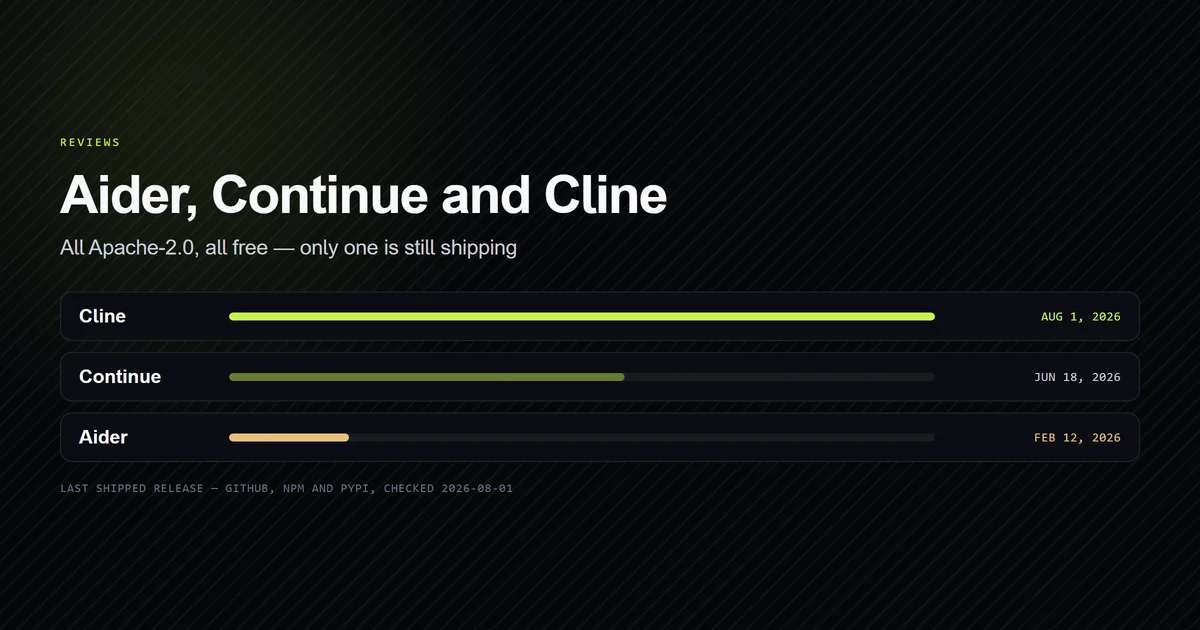
Aider, Continue, and Cline are all Apache-2.0, all free to install, and all bring-your-own-key — so the usual open source ai coding assistant comparison, which ranks them on licence and price, cannot separate them at all. What separates them is whether the project is still moving. We pulled release metadata for all three from the GitHub, PyPI, and npm APIs on August 1, 2026, and the three answers are not close: one shipped that day, one shipped in June, and one has not shipped a release since February.
Key takeaways
- All three are Apache-2.0 and free; the entire cost is inference, billed by whichever model provider you point them at.
- Cline is the most actively maintained — 65,407 stars and a release published on August 1, 2026, the day we checked.
- Aider's last PyPI release is 0.86.2 from February 12, 2026 and its last commit is May 22, 2026, with 1,768 issues open.
- Continue's homepage states it "was acquired by Cursor," which makes the leading open source editor extension a subsidiary of the paid editor it competes with.
- None of the three reads a
CLAUDE.md; each has its own rules format, so an existing Claude Code config does not transfer.
The three tools at a glance
| Project | Surface | Stars · last release |
|---|---|---|
| Cline | VS Code and JetBrains extension | 65,407 · Aug 1, 2026 |
| Aider | Terminal program, Git-native | 47,862 · Feb 12, 2026 (PyPI) |
| Continue | VS Code, JetBrains, and a CLI | 35,263 · Jun 18, 2026 (npm CLI) |
These three sit in the wider field covered by our complete AI coding assistant comparison, which ranks every major tool by where it runs. Every figure in the table above came from the vendors' own distribution channels on August 1, 2026, not from a review roundup. That matters more than usual here, because the thing most open source comparisons get wrong is treating a GitHub star count as a liveness signal. Stars accumulate. Releases do not.
What open source actually buys you here
Three concrete things, and one thing it does not buy. It buys you the licence — all three are Apache-2.0, so you can read the code, fork it, and run it inside a company that will not approve a closed-source agent. A later survey of eleven tools found that distinction is not cosmetic: two of them ship under source-available licences that read as open in a roundup and restrict competing use. It buys you provider choice, because every one of them is bring-your-own-key rather than bound to a single vendor. And it buys you the option of running inference locally.
What it does not buy you is a free tool. The software is free; the model is not. If you point Cline at Claude Opus or Aider at GPT-5, you are on that provider's per-token meter with no seat price wrapped around it, which is a different cost shape from the subscription tiers we broke down in what AI coding assistants actually cost — better if you code in bursts, worse if you code all day. The genuinely $0 configuration is a local model, and that is a real quality trade rather than a free lunch.
Aider has gone quiet
Aider is the most distinctive design of the three and the one with the clearest
maintenance problem. Its two headline mechanisms are real engineering. Architect mode
splits a change across two models: the documentation says "an architect model will
propose changes and an editor model will translate that proposal into specific file
edits," which lets you pair an expensive reasoning model with a cheap editing one. Its
repository map builds "a list of the files in the repo, along with the key symbols which
are defined in each file," then narrows it "using a graph ranking algorithm, computed on
a graph where each source file is a node and edges connect files which have
dependencies." The budget for that map, --map-tokens, "defaults to 1k tokens."
Aider also owns the benchmark the rest of the field quotes. Its polyglot leaderboard "tests LLMs on 225 challenging Exercism coding exercises across C++, Go, Java, JavaScript, Python, and Rust," and the repository's own badge claims 88% of the new code in its last release was written by Aider itself.
Then there is the release history, which we pulled directly:
curl -s https://pypi.org/pypi/aider-chat/json | node -e "let d='';process.stdin.on('data',c=>d+=c).on('end',()=>{const j=JSON.parse(d);console.log(j.info.version, j.releases[j.info.version][0].upload_time_iso_8601)})"
# → 0.86.2 2026-02-12T00:42:52.678771Z

curl -s "https://api.github.com/repos/Aider-AI/aider/commits?per_page=1" | node -e "let d='';process.stdin.on('data',c=>d+=c).on('end',()=>{const j=JSON.parse(d);console.log(j[0].sha.slice(0,7), j[0].commit.author.date, j[0].commit.message.split('\n')[0])})"
# → 5dc9490 2026-05-22T14:02:20Z Merge pull request #5173 from Cyberfilo/feat/anthropic_models-list-add-opus-4-5
Five and a half months since a shipped release, two and a half months since a commit, 1,768 issues open, and the repository is not archived. Read that as slowed rather than dead — but notice what the last commit was. It merged a community pull request adding Claude Opus 4.5 to the model list, and Opus 4.6 has since shipped and is selectable inside GitHub Copilot. A bring-your-own-key tool whose model list lags the models you want to buy is a specific, predictable failure mode, and it is the one to weigh before adopting Aider in 2026. We re-ran this query on 2026-09-17 and the same commit was still the last one — the four-repository activity check puts that interval at 117 days against three rivals that pushed the same day.
Cline ships daily
Cline is the opposite signal on every axis we measured. It carries 65,407 stars against Aider's 47,862, it is Apache-2.0 © Cline Bot Inc., and when we queried the GitHub releases API on August 1, 2026 the most recent release was tagged that same morning. The repository had been pushed to hours before we looked.
Its defining feature is a Plan/Act split that will be familiar if you have used Claude Code's plan mode. The docs are blunt about the boundary: "Plan mode lets you explore and strategize without changing files," and once you are satisfied, "Cline retains the full context from your planning session and can now modify files, run commands, and execute your strategy." You can "cycle between modes multiple times," and — the part that is genuinely well designed — "you can configure separate models for Plan and Act modes," so switching mode switches model automatically. That is Aider's architect/editor idea rebuilt as an interactive toggle rather than a launch flag.
Cline is also the least locked-down on providers. The README states plainly that "Cline is not locked to a single AI provider," listing Anthropic, OpenAI, Gemini, OpenRouter, AWS Bedrock, Ollama, and "any OpenAI-compatible API." The extension itself is free; the company sells an optional hosted provider on usage-based pricing, and bring-your-own-key remains free.
It has also stopped being a VS Code panel since this was written. Cline CLI 2.0 shipped in February 2026, so the same configuration now drives a terminal agent as well, and we take Cline apart against Claude Code on that footing separately.
Continue is open source and owned by Cursor
This is the fact that reframes the category, and it is stated on Continue's own homepage: "Continue was acquired by Cursor." No date is given there, and the company blog's most recent post is from March 6, 2026, so the announcement is not something you can pin down from primary sources — but the acquiring party is the paid AI editor that Continue's extension was the open alternative to.
The project has not stopped. The repository was pushed to on August 1, 2026, it remains
Apache-2.0 at 35,263 stars, and the homepage says "our open-source codebase remains
freely available as a foundation for others." Continue now spans three surfaces — a VS
Code extension, a JetBrains plugin, and a CLI called cn shipped on npm as
@continuedev/cli, whose latest version 1.5.47 published on June 18, 2026. The README is
candid about which surface it trusts: "We recommend using the Continue CLI instead of the
JetBrains plugin." Configuration moved to config.yaml, with config.json deprecated.
If vendor independence is the reason you are reading this at all, that acquisition also changes how the paid editors compare — we price Cursor, Devin Desktop and Cline against each other at individual and team scale, and Cline is the only one of the three that leaves you owning the key.
Aider vs Continue on the work you actually do
The aider vs continue question is usually asked as if the two compete, and they mostly do not — they are different shapes. Aider is a terminal program that edits your working tree and makes a Git commit per change; Continue is an editor extension that keeps the loop inside VS Code or JetBrains, with a CLI added later. Choose on where you already work, the same axis that separates Claude Code from Cursor.
| If you want | Pick | Because |
|---|---|---|
| A reviewable commit per change | Aider | Git-native by design |
| To stay inside your editor | Continue | Extension-first, IDE-native |
| Approval before every action | Cline | Plan/Act with per-step approval |
| The freshest model support | Cline | Only one shipping releases now |
The honest recommendation, on August 1, 2026, is Cline for most people — not because its design is better than Aider's, but because maintenance velocity is the risk that actually bites on a bring-your-own-key tool. Aider is the better pick for anyone whose workflow is Git-shaped and who is content on the models it already supports.
Self hosted AI coding with local models
Self hosted ai coding is the strongest reason to choose any of these three over a subscription tool, and all three support it. Aider's README says it "can connect to almost any LLM, including local models." Cline lists Ollama and LM Studio directly among its providers, and its "any OpenAI-compatible API" support covers everything else — vLLM, llama.cpp's server, an internal gateway.
The catch is the model, not the tool. A local model you can actually serve is several capability tiers below a frontier API model, and agentic editing is exactly the workload that punishes that gap: the agent loops, mis-edits, and burns your time instead of your API budget. Self-hosting is the right call when code cannot leave your network. It is rarely the right call purely to save money, and any comparison that presents it as a free upgrade is selling you something. If the goal is a lower bill rather than data residency, start with the free tiers that actually exist before you buy a GPU.
"A local model you can actually serve" is doing more work in that paragraph than it looks. Measured against an ordinary laptop on 2026-08-18, none of seven quantised coding models fit its GPU and three separate runtimes refused to start — so the tool supporting Ollama is the easy half of the problem.
This section is about the tools: all three can point at a local model, and that is a real advantage over a subscription client. What that swap removes from a whole stack is a separate question with a separate answer, and it is not "everything" — an audit of every outbound service in one repository found the model endpoint was one of seven, with the other six untouched by any choice made here.
None of the three reads your CLAUDE.md
Each of these tools has its own project-instruction format, and none of them is the one
you probably already have. Aider uses CONVENTIONS.md, loaded read-only with
/read CONVENTIONS.md or a read: key in .aider.conf.yml. Cline reads a
.clinerules/ directory at the project root, combining "all .md and .txt files
inside." Continue reads .continue/rules, as .md files with YAML frontmatter, "loaded
in lexicographical order." Cline is the most accommodating — it also picks up
.cursorrules, .windsurfrules, and a global ~/.agents/AGENTS.md — but none of the
three documents CLAUDE.md as a project instruction file.
That is measurable rather than theoretical. This site's repository has a 135-line
CLAUDE.md encoding real build traps, and none of the four files these tools look for:
wc -l CLAUDE.md
# → 135 CLAUDE.md

ls CONVENTIONS.md AGENTS.md .clinerules .continue .aider.conf.yml
# → ls: cannot access 'CONVENTIONS.md': No such file or directory
# → ls: cannot access 'AGENTS.md': No such file or directory
# → ls: cannot access '.clinerules': No such file or directory
# → ls: cannot access '.continue': No such file or directory
# → ls: cannot access '.aider.conf.yml': No such file or directory
Adopting any of the three means re-authoring that context in a new format and then
maintaining two copies of it. That is the reverse of the Copilot situation, where GitHub
documents CLAUDE.md as an agent instruction file and an existing
CLAUDE.md configuration transfers unchanged. The
open source tools are more open and less compatible, which is a genuinely annoying
result and the one most likely to cost you an afternoon.
What we did not test
We did not install or run Aider, Continue, or Cline against this repository, and nothing above is a hands-on quality judgement. Every claim here is either quoted from the project's own documentation and README or measured from its public distribution metadata — GitHub, PyPI, and npm — on August 1, 2026, and the commands that produced those numbers are printed above so you can re-run them.
That is a real limit and it bounds what this article can tell you. It cannot tell you which one writes better diffs, how often each derails on a large refactor, or what an Aider architect/editor pair costs across a working week. It can tell you which projects are shipping, what each one actually claims about itself, and what adopting each would cost you in configuration — which is the part of the decision that most reviews skip and that does not require a subjective verdict.
Common mistakes picking an open source tool
- Reading stars as maintenance. Aider has 47,862 stars and has not shipped a release since February 12, 2026. Star counts are cumulative and never go down; check the release feed instead.
- Assuming open source means free. The licence is free. Inference is not, and a bring-your-own-key tool has no ceiling — it bills until you stop it.
- Expecting your existing config to transfer. Four different rules formats across
these three tools plus Claude Code, and no overlap with
CLAUDE.md. - Choosing self-hosting to save money. Choose it for data residency. Choosing it for cost trades your API bill for your own time at a bad exchange rate.
- Ignoring who owns the project. Continue is open source and owned by the vendor of the paid editor it competes with. That does not make it a bad tool; it makes it a different risk.
- Comparing Aider to Cline as if they were the same product. One is a terminal program built around Git commits; the other is an IDE extension built around per-step approval.
Conclusion
Take Cline if you want an open source ai coding assistant today and have no strong constraint pulling elsewhere — it is Apache-2.0, provider-agnostic, and the only one of the three shipping releases in August 2026. Take Aider if your work is Git-shaped, you value a commit per change, and the models it already supports cover you; check its release feed before you commit to it. Take Continue if you will not leave your IDE and you are comfortable with Cursor owning it. Whichever you pick, set an API spend limit first and budget an afternoon to re-author your project rules — the config does not come with you. If a paid tool is still on the table, weigh these three against the best AI coding assistants overall before you commit — and when the paid tool in question is specifically Claude Code, the Aider head-to-head measures how much of your existing agent configuration would survive the switch, which is where that decision actually lands.
Frequently asked questions
What is the best open source AI coding assistant in 2026?
Is Aider still maintained?
Aider vs Continue — which should I use?
Are these open source tools actually free?
Can I run these fully self hosted with no cloud API?
Do these tools read my existing CLAUDE.md?
Muhammad Kashif
Founder and editor of Devventa, covering AI coding assistants, Next.js and the modern AI development stack.