The honest answer to roocode vs claude code in 2026 is that only one side is still being written.
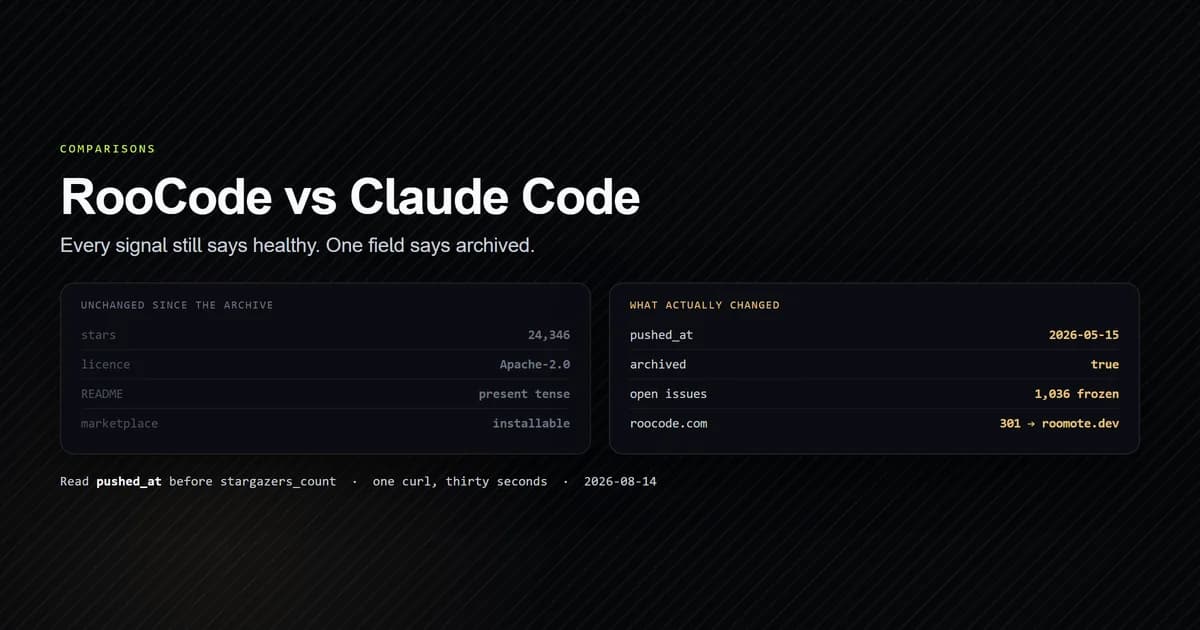
Roo Code was archived on 2026-05-15, sixteen minutes after its final release, and its 1,036 open
issues are frozen exactly where they were. Claude Code shipped v2.1.229 to this machine. This
article gives you the two commands that verify that, the one thing Roo genuinely did better than
the maintained alternatives, and where to take your .roomodes file.
Key takeaways
RooCodeInc/Roo-Codereportsarchived: truewith a final push of 2026-05-15 and a last release, v3.54.0, published sixteen minutes earlier.roocode.comnow returns an HTTP 301 toroomote.dev, a different product, and no migration notice appears at either address.- The archive is silent, not annotated: the README, the repository description and the homepage link all still describe a maintained editor extension.
- Roo's
.roo/mcp.jsonis project-scoped, which Cline's MCP config still is not — an archived tool beats a maintained one on that row. - Kilo Code is the maintained fork and Cline is the upstream. Both are live; Roo's own configuration concepts survive most cleanly in the former.
The short answer
Do not choose Roo Code. Not because Claude Code beats it on features — that comparison was genuinely close while both were shipping — but because a coding agent is only as good as the models it can reach, and a project that stopped in May 2026 will not reach the ones released since.
If you are here because you already run Roo Code, the useful question is not which is better but what your configuration is worth and where it goes. That is the rest of this article. If you are choosing fresh, the best AI coding assistants comparison covers the live field, and our three-way terminal agent comparison covers the ones that run in a shell.
Verifying the archive yourself
Everything above is one request against a public API, and we would rather you checked it than believed us.
curl -s https://api.github.com/repos/RooCodeInc/Roo-Code
  archived            true
  pushed_at           2026-05-15T18:08:47Z
  stargazers_count    24,346
  open_issues_count   1,036
  license             Apache-2.0
  homepage            https://roocode.com
  description         Roo Code gives you a whole dev team of AI agents in your code editor.
The last release is v3.54.0, published 2026-05-15T17:52:24Z — sixteen minutes before the final
push. That ordering is the tell: this was a planned stop, not a project that drifted.
What makes it awkward for anyone arriving from a search engine is the absence of any marker.
The repository description still reads in the present tense. The README still opens with "Your
AI-Powered Dev Team, Right in Your Editor". The homepage field still points at roocode.com. A
developer evaluating Roo Code from the Roo-Code GitHub repository sees a 24,000-star Apache-2.0 project that
looks entirely healthy, unless they happen to notice the archive banner or check pushed_at.
The marketplace is worse, because it publishes a ranking. Counted on 2026-08-20, the extension holds 1,938,656 installs and a 4.72 rating — ninth on installs and second on rating among the eleven extensions in our measured shelf, with nothing in either column indicating the project stopped three months ago.
The redirect nobody explains
The second check is a single curl, and it produced the sharper finding.
curl -s -o /dev/null -w "%{http_code} %{redirect_url}\n" https://roocode.com/
# → 301 https://roomote.dev/

curl -s -o /dev/null -w "%{http_code} %{redirect_url}\n" https://docs.roocode.com/
# → 301 https://roocodeinc.github.io/Roo-Code/
The product site permanently redirects to Roomote, which describes itself as a source-available, self-hosted AI coding teammate that investigates code and opens real pull requests — a background cloud agent, not an editor extension. The documentation redirects somewhere else entirely, to the Roo Code documentation archive on GitHub Pages that still works and which every link in this article relies on.
We read roomote.dev looking for the migration notice. There isn't one. No mention of Roo Code,
no dates, no guidance for existing users. Someone who typed the URL they had bookmarked lands on an
unrelated product page with nothing connecting it to the tool they were looking for.
This is the same shape as the rebrand we caught with Windsurf and Devin
Desktop, where windsurf.com returns a 308 to
devin.ai/desktop — and it is worse in one specific way. That redirect at least lands you on the
successor to the thing you wanted. This one lands you on a different category of product with no
explanation, and the documentation you actually need has moved to a third address.
Re-read on 2026-09-18, all of that still holds, and the page now mentions Roo Code exactly once — inside a customer testimonial. The 125-day follow-up counts what else has not changed: both registries still serve the frozen 3.54.0 build, and both still hand over the package on request.
What the portability audit says anyway
We ran the audit regardless, because the migration question is live even though the comparison is not. The same tooling behind our Aider and Cline write-ups takes a Roo Code target.
npm run check:portability -- --agent=roocode
  ARCHIVED 2026-05-15 — Roo Code is no longer maintained.
  roocode.com now 301-redirects to roomote.dev; the live fork is Kilo Code.
  The verdicts below describe a repository that has stopped moving.

  CONCERN                   CLAUDE CODE                 PRESENT     IN GIT   PORTS AS  ROO CODE
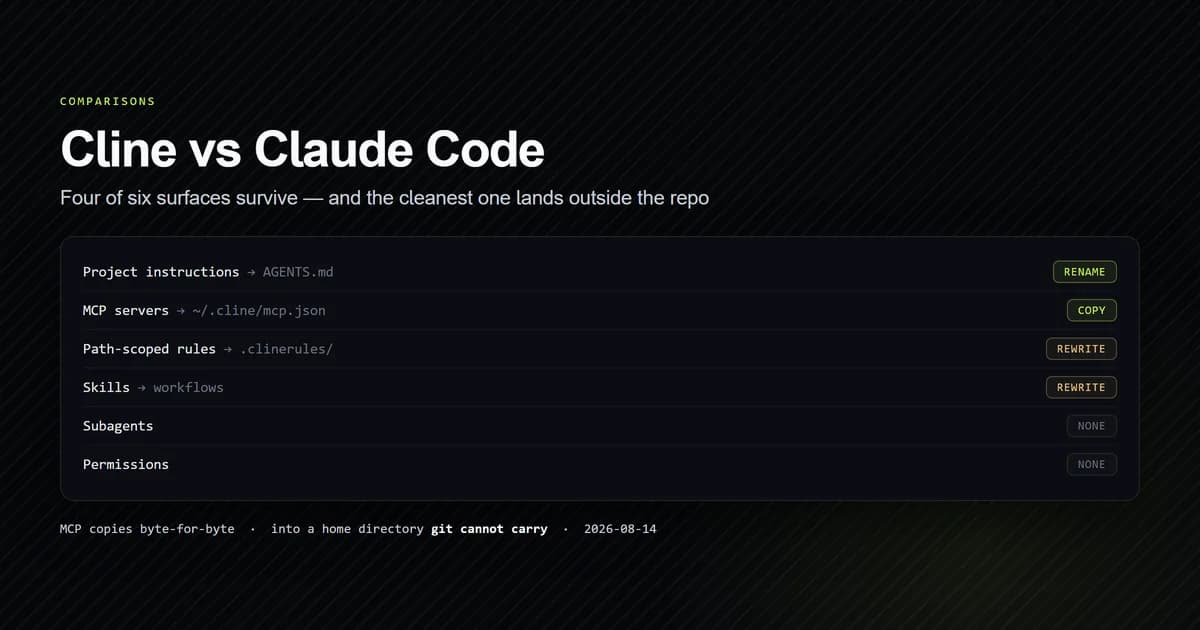
  Project instructions      CLAUDE.md                   8,189 B     yes      rename    AGENTS.md  (or .roo/rules/)
  Path-scoped instructions  .claude/rules/              absent               rewrite   .roo/rules-<mode>/
  MCP servers               .mcp.json                   284 B       yes      copy      .roo/mcp.json
  Subagents                 .claude/agents/             2,443 B     yes      rewrite   .roomodes  (custom modes, YAML)
  Permissions / approvals   .claude/settings.local.json 4,263 B     no       none      alwaysAllow  (per server) / mode groups
  Skills                    .claude/skills/             absent               none      —

  4 of 6 surfaces present. 10,916 B committed, 1 present but not in git — machine-local under either agent.
  Formats in play: markdown, JSON. Roo Code wants: markdown, YAML, JSON.
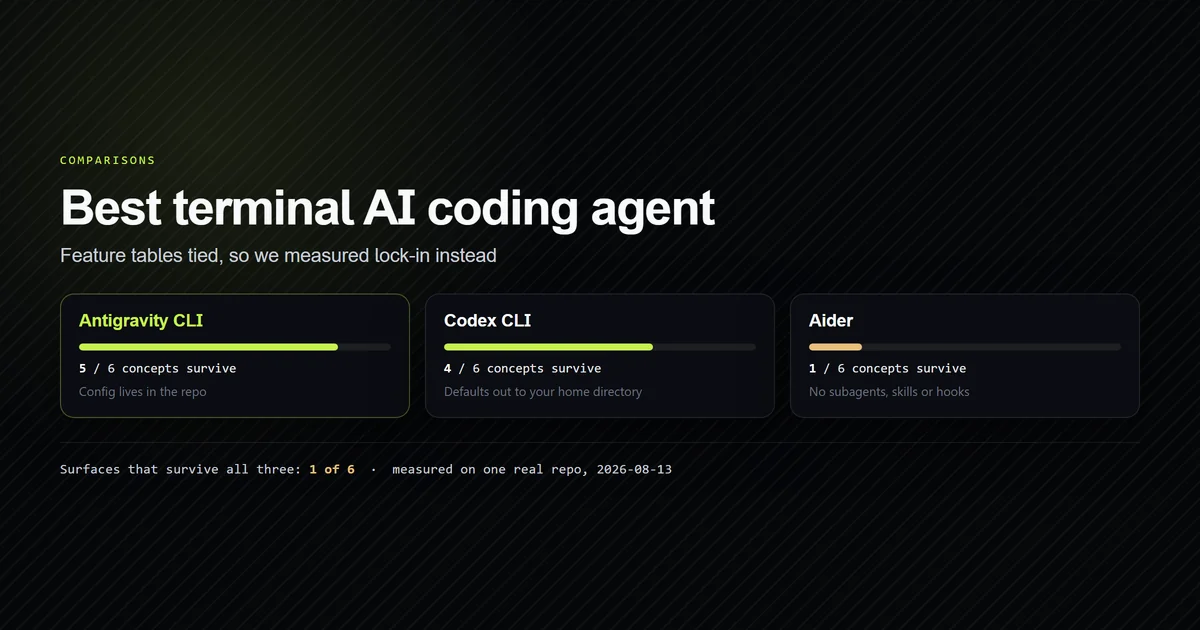
The banner is deliberate and it is the point of running this at all. Four of six concepts survive, which is the same score Cline and Codex CLI get — and the score is not a recommendation. We added that warning to the tool itself rather than only to the article, because the next person to run it will read the table before they read us.
The one thing Roo got right
Roo Code stores MCP servers in .roo/mcp.json, inside the workspace, where a project-level file
takes precedence over the global one. Cline — the project Roo was forked from, and the one still
being actively developed — documents its MCP config only at ~/.cline/mcp.json, with no
project-scoped equivalent in the reference.
So on the row that decides whether your server list is a repository asset or a per-developer
onboarding chore, the archived fork is arranged better than its living upstream. Roo also accepts a
cwd key per server, which gives relative arguments an anchor to resolve against — a gap we hit
directly when auditing Cline, where the same args array means different things in different
files.
That is not an argument for adopting Roo Code. It is an argument for not confusing maintained with
better designed, and for reading the one row you actually care about rather than the total. Under
Claude Code, .mcp.json sits in the repository too, and our
.mcp.json reference covers the schema that both
tools share.
What to carry out of a Roo repository
Four concepts are worth extracting, and they map differently depending on where you go.
.roo/rules/— plain markdown, read recursively. Concatenate it into aCLAUDE.mdat the repository root and you are done; our CLAUDE.md setup guide covers the structure that survives contact with a real project. Name itAGENTS.mdinstead and Cline and Codex CLI read it too.AGENTS.md— if you already used this, you have nothing to do. Roo read it, Cline reads it, Codex CLI and Antigravity CLI read it. It is the one file in this whole category that four of five agents auto-discover..roomodes— custom modes are the interesting case. Each is a named persona with aroleDefinition, agroupsarray controlling tool access, and an optionalfileRegexrestricting which files it may edit. The closest Claude Code concept is a subagent, and the move is a rewrite: YAML entries become markdown files in.claude/agents/..roo/mcp.json— samemcpServerskey and the samecommandandargsshape as Claude Code's.mcp.json. Rename the file, drop it in the repository root, and it works.
The fileRegex restriction has no Claude Code equivalent, and it is the one thing on this list you
genuinely lose. A mode that can only touch \.(js|ts)$ is a guardrail expressed in configuration;
the Claude Code equivalent is a permission allowlist plus an instruction, which is not the same
guarantee.
What to use instead
- Kilo Code, if you want Roo's shape. It began as a Roo fork, shares real git history with it, and carries the same custom-modes and project-rules concepts. It is MIT-licensed and was pushed to on 2026-08-14, the day we checked.
- Cline, if you want the upstream. Roo was forked from it — the lineage is still visible in the marketplace identifier
RooVeterinaryInc.roo-cline— and the Cline GitHub repository is now a terminal agent as well as an extension. Our Cline head-to-head covers what moves and what does not. - Claude Code, if the terminal is where you already work and subagents or a fine-grained permission allowlist matter to you. It is the only tool in this list with both, and it is what this site's own repository is configured for.
- Not Roomote, unless you actually want a background cloud agent that opens pull requests. It is a different product solving a different problem, and inheriting a redirect is not a reason to adopt it.
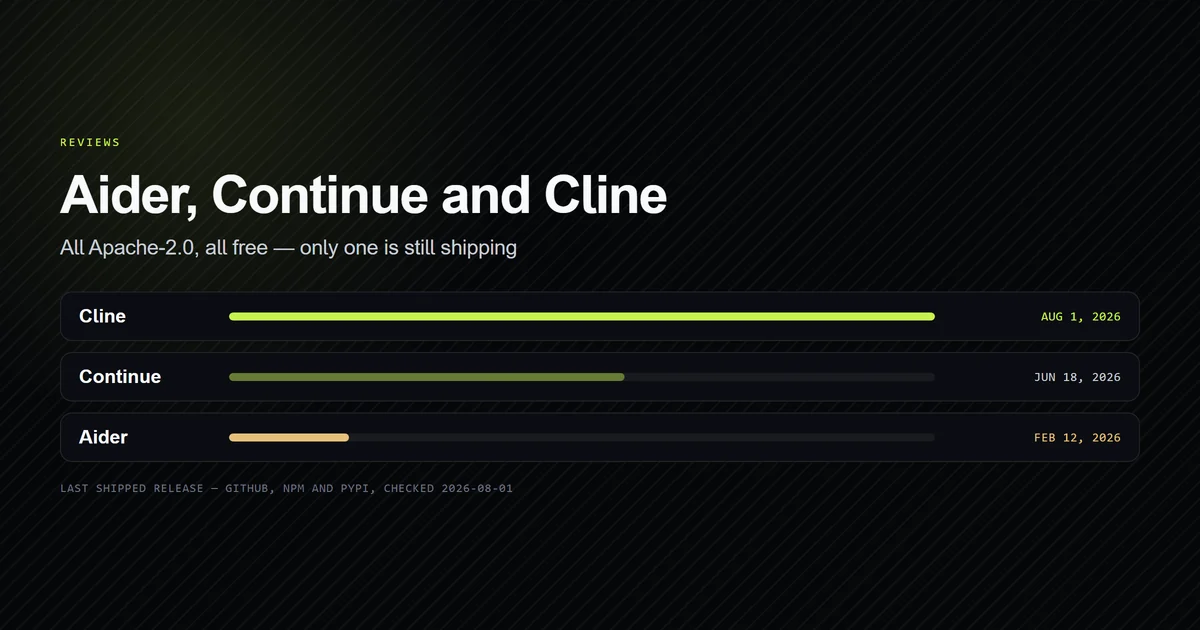
For the wider open-source picture, our open source AI coding tools roundup sets Cline against Aider and Continue on the maintenance signals that turned out to matter here.
125 days on, both registries still serve it
This article said in August that Roo Code stopped moving on 2026-05-15. What it did not check is whether anything downstream noticed. Re-measured 125 days after the final commit:
- Both registries returned HTTP 200 and the real VSIX — 29,954,114 bytes from the Microsoft gallery, 30,837,353 from Open VSX. Same version, 3.54.0, on both.
- Neither listing says a word about it. The marketplace copy still reads "A whole dev team of AI agents in your editor", and the
mainREADME carries no archive notice. RooCodeInc/Roo-Codeis archived with 1,033 issues frozen where they were.
Roo Code is archived and installable at the same time, and nothing in either install path tells you the first half. That is the practical hazard: a developer choosing an editor agent in 2026 can reach a working install of an abandoned project without ever encountering a signal that it is abandoned.
Common mistakes leaving Roo Code
- Judging the project by its README. It was never updated. Every present-tense claim on that page describes a tool that stopped shipping in May.
- Reading 24,346 stars as health. Stars accumulate and never decay.
pushed_atis the field that tells the truth. - Following
roocode.comand assuming Roomote is the successor. It is a different product category, and neither site says otherwise. - Trying to keep the extension "just for now". It will keep working and it will not gain a single new model, which is the one dimension where standing still is a moving loss.
- Porting
.roomodesverbatim to.claude/agents/. The concepts line up; the formats do not. YAML modes withgroupsandfileRegexbecome markdown subagent definitions, and the file restriction does not survive.
Conclusion
Treat roocode vs claude code as a migration question, not a comparison — Roo Code has been archived
since 2026-05-15, and nothing on its own GitHub page or its old domain says so. If you liked Roo
specifically, go to Kilo Code, which shares its history and its concepts. If you want the upstream
that is still shipping several times a day, go to Cline. If you want the terminal and you use
subagents, stay with Claude Code. Whichever you pick, run curl -s https://api.github.com/repos/OWNER/REPO
on it first and read pushed_at before stargazers_count — that habit is the actual lesson here,
and it would have cost thirty seconds in April.
Frequently asked questions
Is Roo Code still maintained in 2026?
Should I pick Roo Code or Claude Code?
What is Roo Code a fork of?
Where did Roo Code go?
Do my .roomodes and .roo/rules files transfer anywhere?
Can you still install Roo Code?
Can Claude Code import my Roo Code configuration?

Muhammad Kashif
Founder and editor of Devventa, covering AI coding assistants, Next.js and the modern AI development stack.