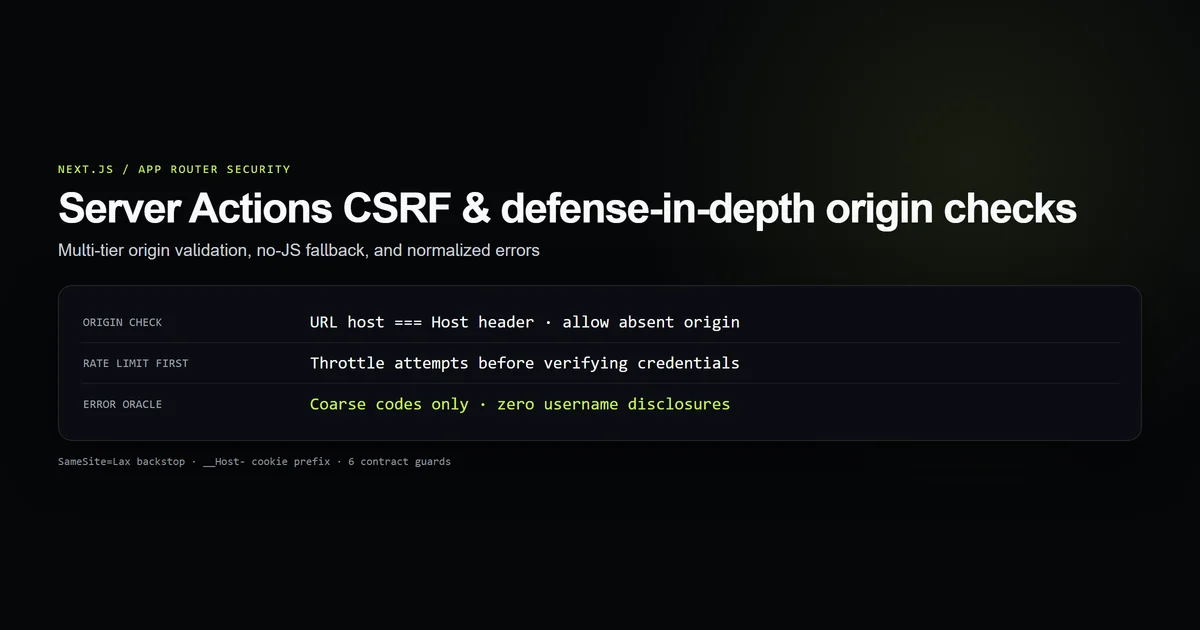
Nextjs server actions csrf defense is built into the framework, but trusting default settings without understanding their mechanics creates subtle vulnerabilities. A reverse proxy misconfiguration, an overly permissive cookie attribute, or an unhandled header edge case can allow cross-site requests to execute unauthorized mutations.
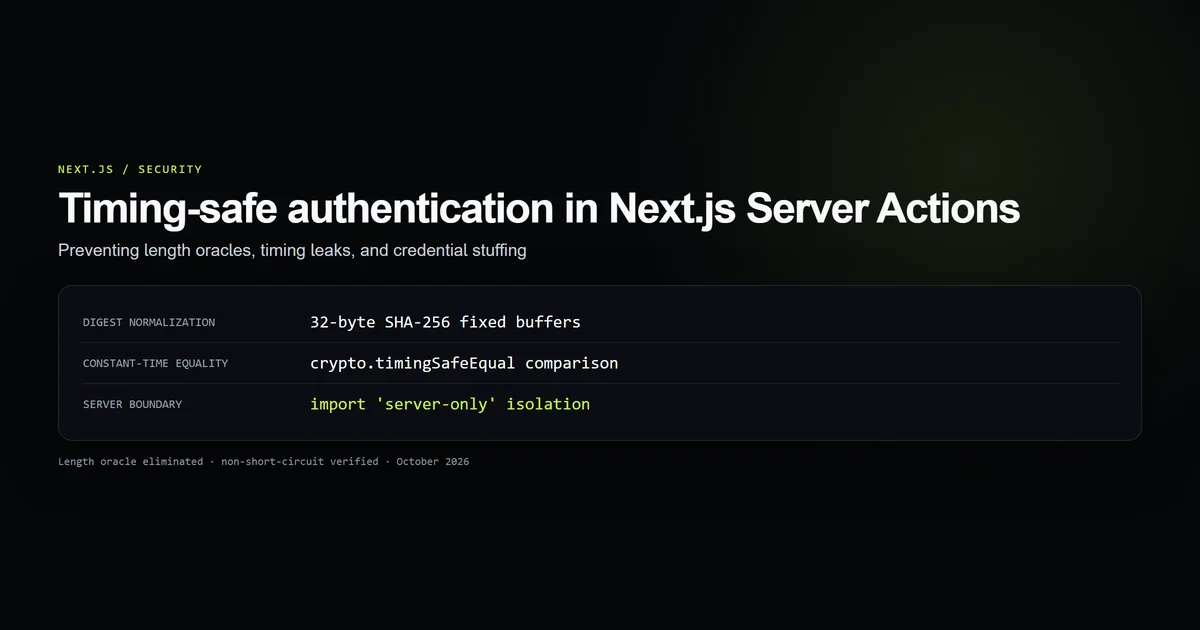
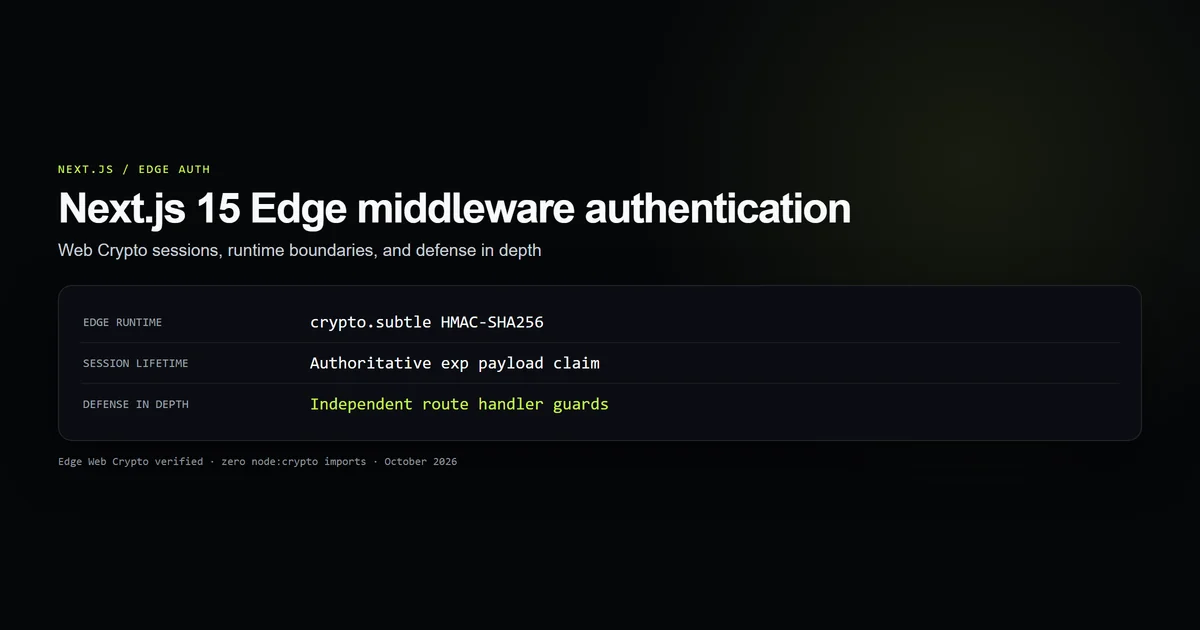
In Next.js App Router, Server Actions execute via HTTP POST requests. Next.js enforces cross-origin protections by verifying the Origin header against the Host header. Pairing this with timing-safe authentication and Edge middleware session verification establishes an explicit, multi-layered security boundary.
Key takeaways
- Next.js automatically compares
OriginagainstHostfor Server Actions, rejecting mismatches with HTTP 403. - Implementing application-level origin verification adds defense-in-depth against proxy misconfigurations.
- Native HTML forms without JavaScript may omit the
Originheader; allow absentOriginonly when paired withSameSite=Laxcookies. - Execute rate limiting before evaluating credentials to prevent denial-of-service and credential stuffing.
- Use coarse redirect error codes rather than serialized component state to eliminate username enumeration oracles.
Nextjs server actions csrf protection relies on origin matching
When a client invokes a Server Action, Next.js dispatches a POST request with the Next-Action header. Because Server Actions rely on cookies for authentication, an attacker hosting an external website could theoretically trick a user's browser into submitting an unauthorized request across origins.
Next.js mitigates this at the framework layer by inspecting incoming headers:
POST /admin/login HTTP/1.1
Host: devventa.com
Origin: https://evil.com
Next-Action: c4b18c...
If the hostname extracted from Origin does not match the Host header, Next.js halts execution immediately. However, framework defaults alone are vulnerable to edge cases:
- Reverse proxy rewrites: Misconfigured reverse proxies (such as Nginx, Cloudflare, or AWS ALB) often rewrite
Hostto an internal container address (likelocalhost:3000) while passing the public domain inX-Forwarded-Host. If Next.js comparesOriginagainst an internalHost, requests either fail unconditionally or allow spoofed values. - CSRF on non-action routes: Traditional route handlers (
app/api/) do not participate in Server Action origin checks and require manual protection. - JavaScript-disabled clients: Native HTML forms submitting to Server Actions may omit the
Originheader in certain browsers, requiring deliberate fallback logic.
A three-tier CSRF defense architecture
Devventa secures administrative mutations in app/admin/actions.ts using three interlocking layers:
| Layer | Responsibility | Failure Behavior |
|---|---|---|
| Framework Check | Default Next.js Origin vs Host comparison | HTTP 403 Forbidden |
| Action-Level Guard | isSameOrigin(headers) in Server Action body | Redirects to ?error=invalid |
| Cookie Attributes | SameSite=Lax, HttpOnly, __Host- prefix | Browser withholds cookie on cross-site POST |
This design guarantees that even if a proxy rewrite bypasses the framework layer, the action rejects untrusted submissions before parsing body arguments or executing database queries.
Implement strict same-origin validation in actions
In app/admin/actions.ts, the isSameOrigin helper verifies the incoming request headers before any credential or payload inspection:
function isSameOrigin(requestHeaders: Headers): boolean {
  const origin = requestHeaders.get("origin");
  if (!origin) return true;

  const host = requestHeaders.get("host");
  if (!host) return false;

  try {
    return new URL(origin).host === host;
  } catch {
    return false;
  }
}
The function executes three distinct safety steps:
- Step 1: If
originis absent, it returnstrueto accommodate native same-origin form submissions. - Step 2: If
originexists buthostis absent, it fails closed by returningfalse. - Step 3: It parses
originusingnew URL(). If the URL is malformed or uses an invalid scheme (such asjavascript:), thecatchblock returnsfalse. Only an exact match betweennew URL(origin).hostandhostpasses.
Support no-javascript forms without lowering security
Why allow an absent Origin header? When a user submits a native <form method="POST"> without JavaScript enabled, browsers adhering to older specifications omit Origin and include only Referer or neither header for same-origin requests.
Rejecting all requests lacking Origin breaks progressive enhancement. Allowing absent Origin remains secure because cross-site requests cannot forge this condition:
- When an external site (
https://evil.com) initiates a fetch or form POST to your domain, modern browsers unconditionally attachOrigin: https://evil.com. - The attacker cannot delete or strip the
Originheader from a cross-origin browser request. - The session cookie is configured with
SameSite=Lax. Cross-site POST requests from external domains never include the cookie, leaving the request unauthenticated. - Pairing origin validation with a strict Content Security Policy ensures that third-party scripts cannot inject inline payload handlers or execute unauthorized form triggers.
This behavior is enforced in lib/admin/session.ts:
export function sessionCookieOptions(maxAge: number = SESSION_TTL_SECONDS): SessionCookieOptions {
  return {
    httpOnly: true,
    secure: process.env.NODE_ENV === "production",
    sameSite: "lax",
    path: "/",
    maxAge,
  };
}
In production, the cookie name also gains the __Host- prefix (__Host-devventa_admin_session). This browser-level directive ensures the cookie is locked to the specific host, requires HTTPS, and cannot be overwritten by subdomain cookies.
Throttle requests before inspecting credentials
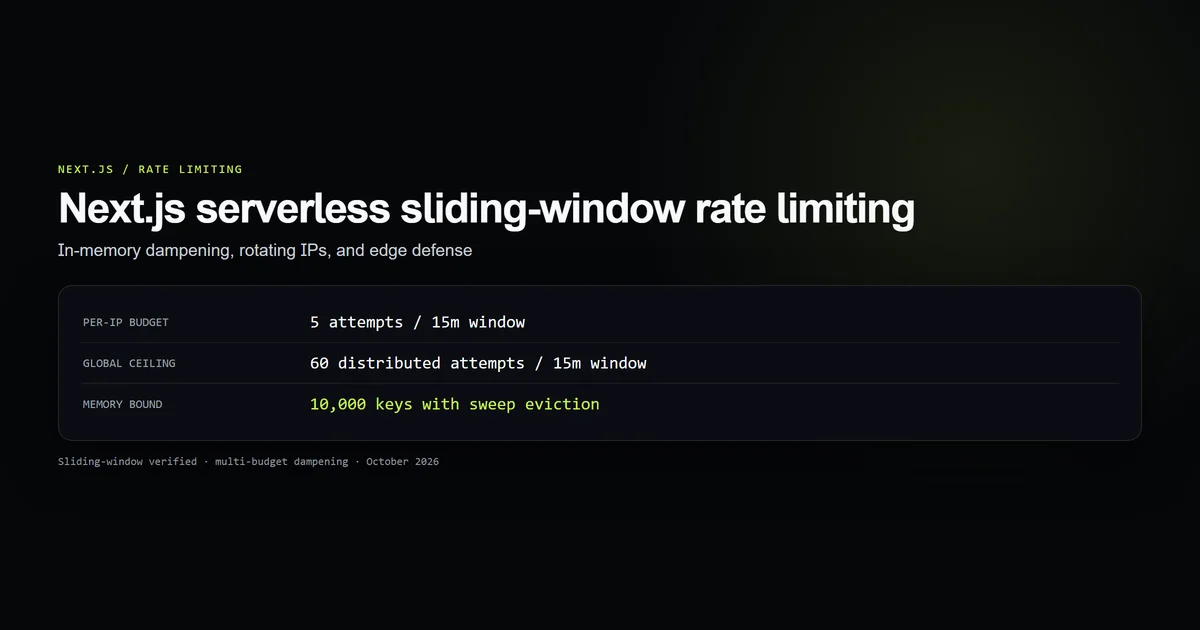
A common flaw in Server Actions is validating user credentials before checking rate limits. This allows attackers to perform timing attacks against authentication logic and consume CPU hashing passwords.
In app/admin/actions.ts, the rate limit gate runs immediately after the origin check:
export async function login(formData: FormData): Promise<void> {
  const requestHeaders = await headers();

  if (!isSameOrigin(requestHeaders)) {
    console.warn("[admin] login rejected — cross-origin submission");
    redirect(`${LOGIN_PATH}?error=invalid`);
  }

  if (!isAdminConfigured()) {
    console.error("[admin] login unavailable — ADMIN_* environment variables missing or weak");
    redirect(`${LOGIN_PATH}?error=unavailable`);
  }

  // Counted before credentials are examined to throttle brute-force floods
  const { allowed } = checkLoginRateLimit(clientIp(requestHeaders));
  if (!allowed) {
    console.warn("[admin] login rate limited");
    redirect(`${LOGIN_PATH}?error=rate`);
  }

  if (!verifyCredentials(formData.get("username"), formData.get("password"))) {
    console.warn("[admin] login failed — invalid credentials");
    redirect(`${LOGIN_PATH}?error=invalid`);
  }

  // Mint session and set cookie...
}
Throttling by client IP via serverless rate limiting before invoking expensive cryptography prevents server resource exhaustion.
Normalize error states to prevent user enumeration
Server Actions often return rich objects back to client components:
// Flawed implementation
return { error: "User not found" }; // Leaks account existence
Serializing detailed error structures across the network boundary creates a username enumeration oracle. An attacker can submit lists of email addresses and observe whether the response indicates a missing user or an incorrect password.
Devventa eliminates this by using coarse redirect codes:
export type LoginErrorCode = "invalid" | "rate" | "unavailable";
All failed attempts redirect to ${LOGIN_PATH}?error=invalid. The server logs record whether the failure was an unknown username or invalid password, but the client response is identical. Furthermore, log lines never print formData.get("username") or passwords, ensuring that logs remain clean of credential fragments.
Verify the server action contract with automated guards
Devventa asserts these security invariants using an automated test suite in scripts/check-server-actions-csrf.mjs:
- Step 1: Verifies that
isSameOriginpermits missing origin for same-origin forms while rejecting mismatched or spoofed domains. - Step 2: Tests that malformed URLs in the
Originheader fail closed without throwing unhandled exceptions. - Step 3: Verifies that
login()explicitly gates execution behindisSameOriginbefore reading form payloads. - Step 4: Asserts that
checkLoginRateLimitexecutes strictly beforeverifyCredentials. - Step 5: Tests that error codes are restricted to the coarse
LoginErrorCodeunion and that credentials are not logged. - Step 6: Confirms session cookie options enforce
httpOnly: true,sameSite: "lax", andsecure: truein production.
Our latest run of that suite:
npm run check:server-actions-csrf
# Output
Running check:server-actions-csrf...
  [ok] Guard 1: isSameOrigin correctly validates matching hosts and rejects untrusted origins.
  [ok] Guard 2: malformed or unexpected origin schemes fail closed without throwing unhandled exceptions.
  [ok] Guard 3: Server Action explicitly gates execution behind isSameOrigin before inspecting body.
  [ok] Guard 4: rate limiting executes strictly before credential evaluation inside login().
  [ok] Guard 5: error states are normalized to three coarse codes and credentials are never logged.
  [ok] Guard 6: session cookie enforces httpOnly, SameSite=Lax, Secure in prod, and Path=/.
All 6 Server Actions CSRF contract guards passed cleanly.
Common Server Actions security mistakes
- Mistake 1: Disabling Next.js origin checks to fix proxy errors. When developers encounter 403 Forbidden errors behind a reverse proxy, the temptation is setting
allowedOriginsto wildcard values. The fix is configuring the proxy to forward the originalHostheader viaproxy_set_header Host $host. - Mistake 2: Relying solely on middleware for action security. Next.js middleware runs on initial request ingress, but Server Actions invoke specific internal endpoints. Never rely on middleware as your sole access boundary; verify authorization inside the Server Action itself.
- Mistake 3: Returning detailed authentication errors. Distinguishing between "wrong password" and "user does not exist" helps attackers map valid accounts. Always normalize failed login errors to a single generic response.
- Mistake 4: Using SameSite=None on administrative cookies. Setting
SameSite=Noneallows cookies to be sent on cross-site requests, entirely bypassing browser-level CSRF defenses. Restrict administrative session cookies toSameSite=LaxorSameSite=Strict. - Mistake 5: Storing sensitive form state in the client. Using useActionState in form validation with unencrypted server error payloads can expose backend exceptions in client memory. Keep administrative actions server-only with redirect-based error feedback.
Conclusion: Defense-in-depth for mutations
Server Actions provide a streamlined model for web mutations, but convenience must not replace security hygiene. Treat every Server Action as a public HTTP endpoint: validate origins, rate-limit ingress before cryptographic operations, enforce strict cookie attributes, and normalize error responses.
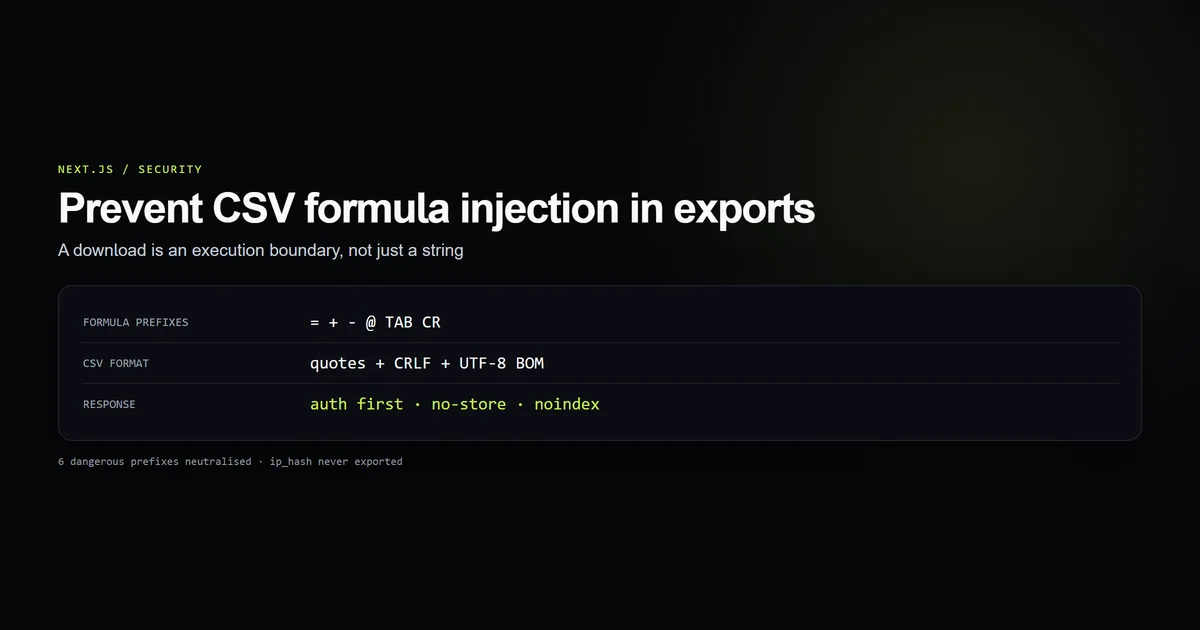
For additional backend patterns, see form validation with useActionState, preventing CSV injection in exports and timing-safe authentication in Server Actions.
Frequently asked questions
Does Next.js App Router protect Server Actions from CSRF automatically?
Why is SameSite=Lax not sufficient for complete CSRF protection?
Why do some browsers omit the Origin header on form submissions?
Should Server Actions return validation errors in state or redirect?

Muhammad Kashif
Founder and editor of Devventa, covering AI coding assistants, Next.js and the modern AI development stack.