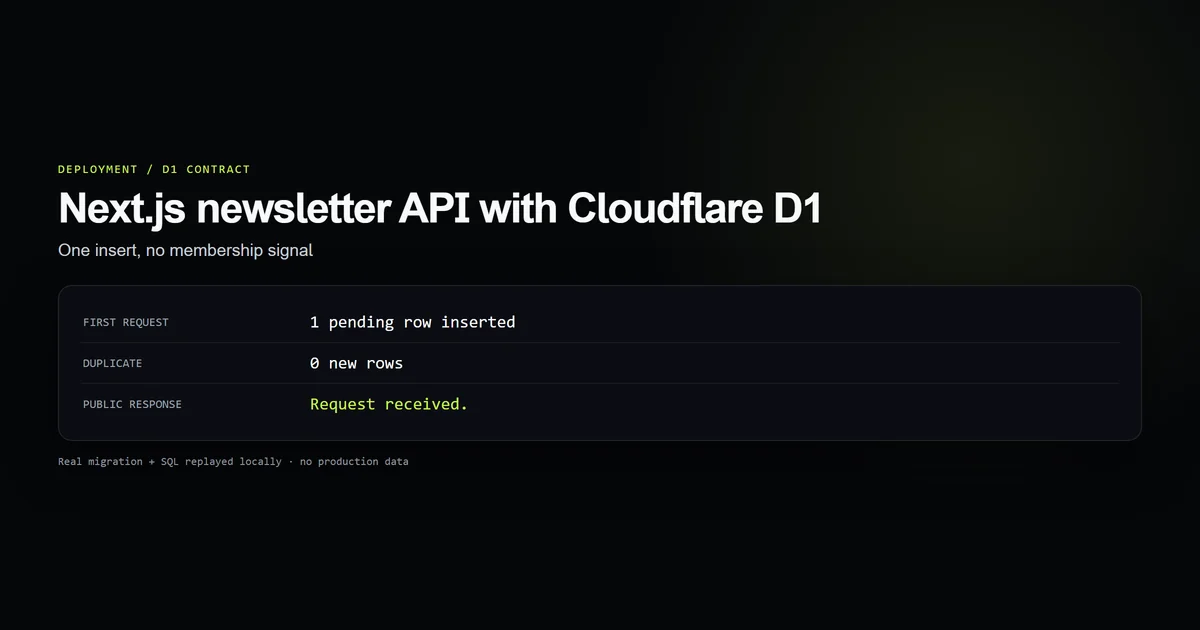
A Next.js newsletter API with Cloudflare D1 can accept a signup in one atomic insert and return the same public response for new and existing addresses. The database owns duplicate prevention; the route owns validation and error handling. This site's D1 and Vercel architecture explains why the Next.js process uses Cloudflare's HTTP query API instead of a Workers env.DB binding. Here we replay the real migration and insert statement in local SQLite, then inspect the route's response contract. The October 13, 2026 check passed 15 guards without touching subscriber data or production D1.
Key takeaways
- The
emailcolumn is unique, andON CONFLICT (email) DO NOTHINGmakes a second identical signup a zero-row write. - The route logs whether a row was created but gives both outcomes the same success response, avoiding an email-enumeration signal.
- The route checks the actual body size after reading it; a client can omit or lie about
Content-Length. - This site has no confirmation-email flow yet. New records stay
pending; its earlier “check your inbox” copy was corrected during this review.
The route contract
The route lives at app/api/newsletter/route.ts, exports POST, and runs in the Node.js runtime because its helper hashes an IP with node:crypto. Next.js route handlers use the standard Request API and are not cached by default for POST. The site marks the route dynamic explicitly and returns Cache-Control: no-store on success.
The intended public outcomes are simple:
| Condition | HTTP response | What the caller learns |
|---|---|---|
| New or existing valid email | 201, neutral message | Request accepted; no membership signal |
| Invalid email or malformed JSON | 400 | Input needs correction |
| Oversized body | 413 | Request exceeds the 2,048-byte bound |
| Unsupported content type | 415 | Send JSON |
| Local rate limit | 429 with Retry-After | Pause before retrying |
| Missing D1 config | 503 | Service is unavailable |
The 201 response on an existing address is a deliberate privacy choice. It does not mean the database created a second row. The route can log that private outcome without exposing it to the requester.
Make duplicates atomic in D1
The migration defines email TEXT NOT NULL UNIQUE. lib/newsletter.ts normalizes an address by trimming and lowercasing it before writing, then uses this insert:
INSERT INTO newsletter_subscribers (email, status, source, ip_hash)
VALUES (?, 'pending', ?, ?)
ON CONFLICT (email) DO NOTHING
d1Query sends the SQL and parameters to Cloudflare's D1 query API. Binding values through the params array keeps email and source text out of SQL construction. The D1 prepared statement documentation describes the same parameter-binding principle for Worker bindings.
We loaded the committed migration into an in-memory SQLite database and ran the exact insert string extracted from the source file twice with reader@example.test. The first call changed one row. The second changed zero. A count query found one row with status = 'pending'. This proves the local SQL contract, not the availability or credentials of production D1.
Keep the public response neutral
subscribe() reads meta.changes and returns created or duplicate to the route. The route writes that distinction to its server log, then responds with the same Request received. message. That blocks a straightforward account-enumeration probe through the response body.
The route also has a honeypot field. When a bot fills the hidden company input, it returns the same neutral response without writing a row. That is a low-cost filter, not a substitute for a durable rate limit. The five-requests-per-minute map is in process memory, so parallel or recycled Vercel instances do not share its state. Our security risks guide documents the same serverless boundary, and our teardown on Next.js serverless rate limiting details the two-tier sliding window contract that dampens bursts across warm instances.
Handle malformed and oversized requests
The handler checks Content-Type, rejects a declared body over 2,048 bytes, reads the body, and checks its actual length before parsing JSON. It handles an unreadable body, an empty body, malformed JSON, and a non-object value separately. A header-only size limit would trust client-supplied Content-Length, which can be absent.
Server-side validateEmail imposes a 254-character total limit and a 64-character local-part limit before applying its practical pattern. The browser check is only a convenience; the API is the enforcement point. normaliseSource truncates free-text provenance to 120 characters. The stored IP value is a salted hash when a salt exists, and null otherwise; the raw address is not written to D1.
The confirmation step is still missing
This site does not send a confirmation email. The migration comments call pending the state “until a confirmation email is wired up,” and no confirmation endpoint exists. While reviewing the route for this article, we found the success message told people to check their inbox to confirm. Both the API response and the form fallbacks now say Request received.
That correction is the important boundary: an idempotent signup is not double opt-in. Do not count a pending row as a confirmed subscriber, and do not tell a reader to expect an email the product cannot send. A future confirmation flow needs a token, expiry, sender, verification endpoint, and explicit state transition; this article does not claim those are implemented.
Best practices
- Let the database reject duplicates. A prior read can race with another signup.
- Normalize before writing. The unique constraint compares stored strings, so case and whitespace must be handled first.
- Keep existence private. Log the insert outcome internally and return one public response.
- Test the actual SQL. The local checker runs the migration and extracted insert, not a rewritten imitation.
Common mistakes
- Checking, then inserting. Two concurrent requests can pass the check. Use one unique constraint and conflict-handled insert.
- Trusting
Content-Length. A missing or false header bypasses that guard. Bound the body after reading it too. - Calling an instance map a durable limiter. It resets and does not span functions. Put serious abuse controls at the edge or in shared storage.
- Promising confirmation without a sender. The symptom was copy directing users to an email that never existed. Keep public copy aligned with the implemented state machine.
Conclusion
Start a Next.js and D1 newsletter route with a unique email column, one conflict-handled insert, and a neutral response for both database outcomes. Add bounded input handling and an abuse layer appropriate to serverless hosting. When those rows leave the database, the secure Next.js CSV export guide covers formula neutralization, RFC 4180 quoting, privacy, and download headers. This site's local SQLite replay proves the duplicate and pending-state behavior, while the copy correction makes its current limits explicit. For the transport and credential setup behind the insert, read the D1 on Vercel guide.
Frequently asked questions
How do I prevent duplicate newsletter signups in Cloudflare D1?
Should the API tell users an email address is already subscribed?
Does this newsletter API send a confirmation email?
Can an in-memory rate limiter protect a Vercel newsletter route?

Muhammad Kashif
Founder and editor of Devventa, covering AI coding assistants, Next.js and the modern AI development stack.