Every ranking of the best terminal AI coding tools has the same problem in 2026: the category will not hold still long enough to be ranked. Of ten agents we surveyed on 2026-08-14, one had been archived, two had changed GitHub organisation, and one had grown a terminal interface it did not have a year ago. Eight of them had shipped code within the previous 24 hours. This article gives you the survey, the script that produces it, and the two signals worth choosing on once the feature lists have converged.
Key takeaways
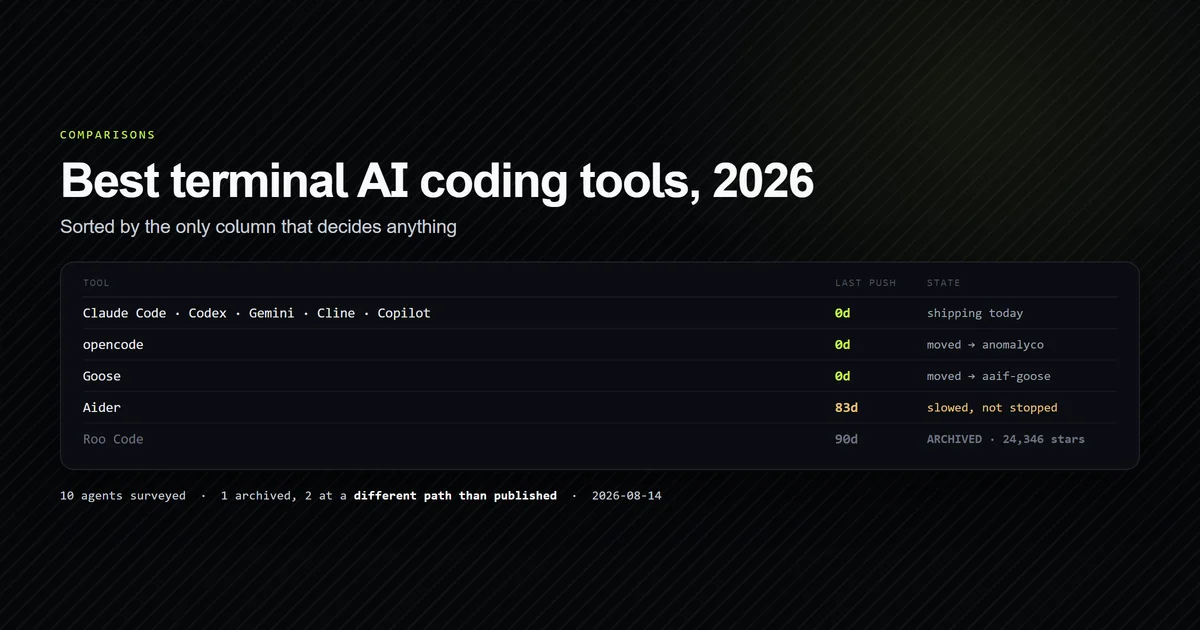
- Eight of ten surveyed projects were pushed to within a day of measurement. Aider was the outlier at 83 days, and Roo Code is archived.
- Two of ten sit at a different GitHub path than the one every write-up published —
sst/opencodeandblock/gooseboth 301 to new organisations. - Cline shipped a CLI in February 2026, so "terminal agent versus editor extension" is no longer a category boundary.
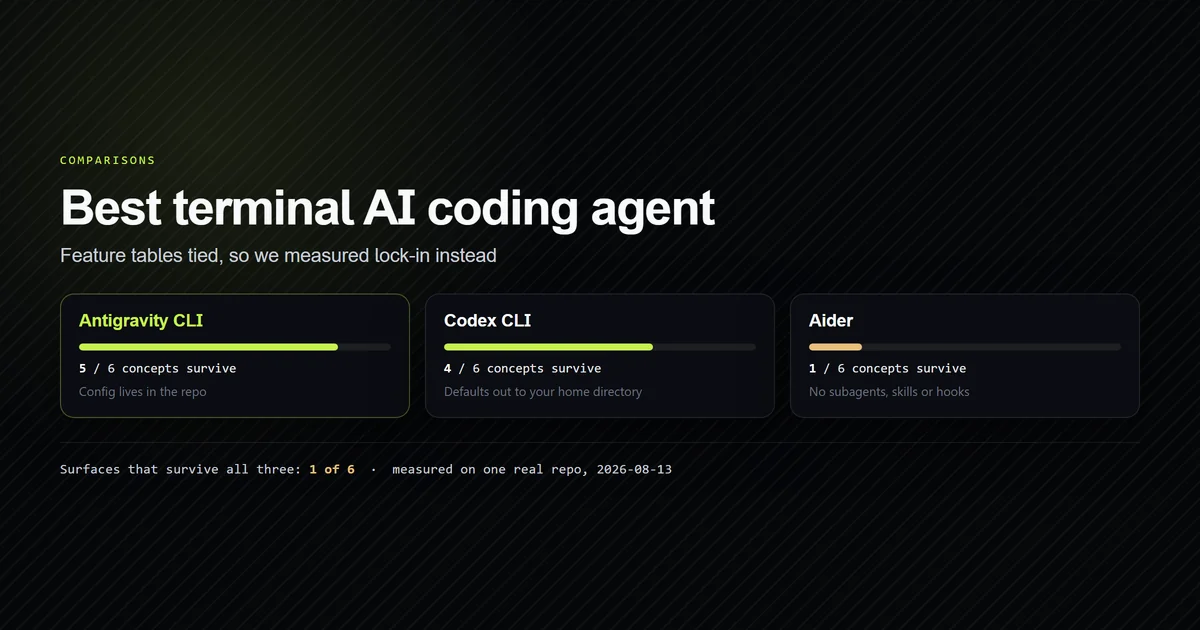
- Configuration is the real switching cost: exactly one of six config surfaces survives a move to all five agents we have audited, and permission allowlists survive none of them.
- Star count is the worst available maintenance signal.
pushed_atis one API field away and does not lie.
The short answer
Use Claude Code if you are already in the terminal and your configuration is a team asset — it is the only agent in this survey with both subagents and a fine-grained permissions system, and it is what this site's repository is configured for. Use opencode or Goose if the licence matters: both are permissively licensed, both are shipping daily, and opencode carries more GitHub stars than any agent here. Use Cline if you want one agent across the terminal, VS Code and JetBrains. Use Aider only after checking its release feed, for reasons the survey below makes plain.
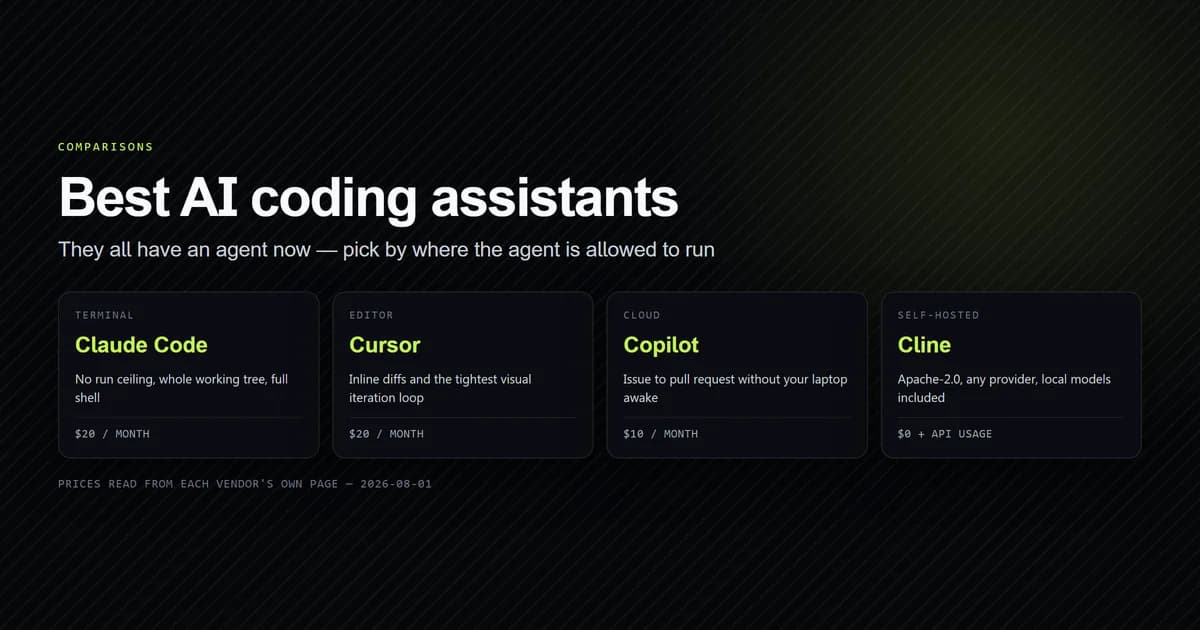
That is a recommendation on configuration, licence and cadence — the three things measurable from outside. It is not a ranking on output quality, and the section on what we are not claiming says exactly why. For the whole-category decision including editors and IDEs, the best AI coding assistants comparison is the pillar this sits under.
The field, measured today
This survey comes from an internal script rather than a hand-maintained table, so we can re-run it against the same public API whenever we want to check whether it has gone stale.
npm run check:field -- --all
Coding agent field check — 10 tools

  TOOL          FORM            LAST PUSH    AGE     STARS    LICENCE      STATE
  Claude Code   terminal        2026-08-13   0d      141,414  none         active
  Codex CLI     terminal        2026-08-14   0d      105,896  Apache-2.0   active
  Gemini CLI    terminal        2026-08-14   0d      106,513  Apache-2.0   active
  opencode      terminal        2026-08-14   0d      197,320  MIT          moved → anomalyco/opencode
  Goose         terminal        2026-08-14   0d      52,791   Apache-2.0   moved → aaif-goose/goose
  Copilot CLI   terminal        2026-08-14   0d      11,090   NOASSERTION  active
  Cline         terminal + IDE  2026-08-14   0d      66,165   Apache-2.0   active
  Kilo Code     IDE             2026-08-14   0d      26,866   MIT          active
  Aider         terminal        2026-05-22   83d     48,189   Apache-2.0   active
  Roo Code      IDE             2026-05-15   90d     24,346   Apache-2.0   ARCHIVED

  9 moving, 0 stale, 1 archived, 2 at a different path than published.

  Changed organisation — every write-up citing the old path now links a redirect:
    sst/opencode  →  anomalyco/opencode
    block/goose  →  aaif-goose/goose

  Archived — still installable, still starred, no longer shipping:
    Roo Code    last push 2026-05-15, 24,346 stars
Three things in that output are worth more than the ordering.
The two redirects. sst/opencode and block/goose are the paths published in essentially every
comparison of this category, including ones written this year. Both now 301 to a different
organisation. Nothing is broken — GitHub redirects cleanly — but "the repo I linked still resolves"
and "the project is where I said it was" have quietly stopped being the same statement.
Aider at 83 days. It is seven days from tripping our staleness threshold, and it is the only tool here not shipping within the week. That figure confirms this site's own earlier measurement: we recorded the last commit as 2026-05-22 when auditing the open-source tools, and defended that dated figure against a live check that returned something ambiguous. The repository is not archived, so read it as slowed rather than stopped.
Roo Code at 24,346 stars and archived. That pairing is the whole argument for reading
pushed_at first.
The install side of that pairing was counted later: Roo Code still carries 1,938,656 marketplace installs and a 4.72 rating three months after the final commit, one of several entries in the measured shelf of AI coding tools that the stores rank highly and never mark.
What "terminal agent" stopped meaning in 2026
The category had a clean boundary until recently: agents that live in a shell on one side, editor extensions on the other. That boundary is now gone in both directions, which is why older rankings mislead even when every individual fact in them is still true.
Extensions grew terminals. Cline shipped CLI 2.0
in February 2026 — npm i -g cline, interactive or headless, with --json output for CI. It is now
a VS Code extension, a JetBrains plugin, an SDK and a terminal agent, and the same configuration
serves all of them. Any comparison treating Cline as the non-terminal option is answering a question
nobody asked; ours treats it as a terminal peer.
Terminals stopped. Roo Code archived in May. Gemini CLI's repository is still busy, but the product's individual-tier access changed in June, which is why we compared against Antigravity CLI rather than writing the Gemini CLI head-to-head the keyword data asked for (see our Antigravity CLI vs Gemini CLI migration guide for the full conversion).
Projects moved house. Two of ten changed organisation this year.
The practical consequence: a ranking is a snapshot of a category with a three-month half-life, and the things that stay true for longer are structural — what licence it carries, whose models it can reach, and whether your configuration survives a switch.
Ranking on what actually survives
Here is the field ordered by how much of a working setup you keep, which is the axis that costs you a day when you get it wrong.
| Tool | Licence | Model access | Config portability |
|---|---|---|---|
| Claude Code | Proprietary | Anthropic only | Reference point |
| Antigravity CLI | Proprietary | 5 of 6 concepts survive | |
| Codex CLI | Apache-2.0 | OpenAI | 4 of 6, with a silent byte cap |
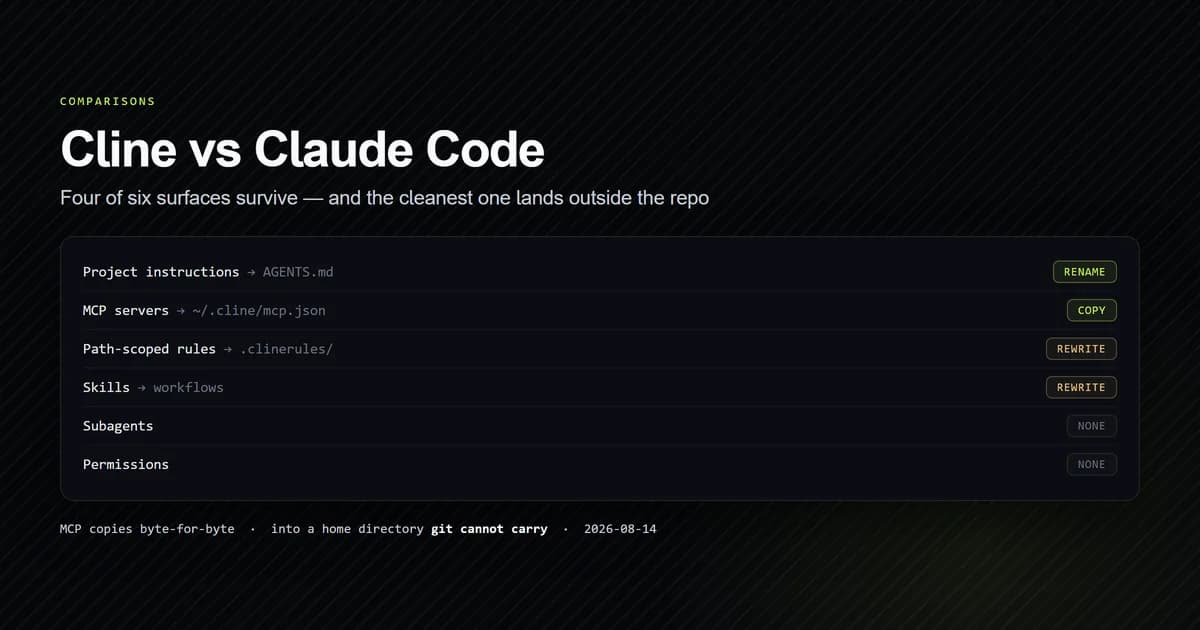
| Cline | Apache-2.0 | Any, your key | 4 of 6, MCP lands in ~ |
| opencode | MIT | Any, your key | Not yet audited |
| Goose | Apache-2.0 | Any, your key | Not yet audited |
| Aider | Apache-2.0 | Any, your key | 1 of 6 |
The portability column comes from a committed audit of this repository rather than from vendor claims, and the measured three-way between Claude Code, Codex CLI and Antigravity CLI is where that method is set out in full. This article deliberately does not re-run it — that comparison goes deep on three tools, this one covers the field and the durability signals around it.
Configuration is the real switching cost
Five of these agents have now been audited against the same repository, and the aggregate is more useful than any individual score.
npm run check:portability -- --matrix --all
  CONCERN                   PRESENT     CODEX CLI         ANTIGRAVITY CLI   AIDER             CLINE             ROO CODE
  Project instructions      8,189 B     rename            rename            declare           rename            rename
  Path-scoped instructions  absent      none              rewrite           none              rewrite           rewrite
  MCP servers               284 B       rewrite           copy              none              copy              copy
  Subagents                 2,443 B     rewrite           rename            none              none              rewrite
  Permissions / approvals   4,263 B     none              none              none              none              none
  Skills                    absent      rewrite           rename            none              rewrite           none

  Concept survives                      4 / 6             5 / 6             1 / 6             4 / 6             4 / 6
  Ports without editing the file        0 / 6             1 / 6             1 / 6             1 / 6             1 / 6
  Config lives in the repo              no                yes               yes               no                yes
  Instruction file auto-discovered      AGENTS.md         AGENTS.md         none              AGENTS.md         AGENTS.md

  Surfaces that survive all 5 targets: 1 of 6 — project instructions.
Two rows decide most migrations.
AGENTS.md won. Four of the five agents auto-discover it, and the fifth discovers nothing at
all. If you write one file for your agent to read, that is its filename — rename CLAUDE.md today
and leave a one-line @AGENTS.md import behind so Claude Code still reads it. It costs a line and
it is the only piece of a setup that travels anywhere.
Permissions survive nothing. That row returns none for all five targets, and not through
oversight — Codex isolates at the OS level, Claude Code allowlists individual tool calls, Cline and
Aider expose a single auto-approve switch. These are genuinely different theories of trust with no
translation between them. Whatever you have taught an agent to permit gets taught again from
scratch, and on this repository that is 4,263 bytes of accumulated allowlist which is not in git
anyway.
Where each one wins
- Claude Code — subagents architecture, a real permission allowlist, and instruction files loaded in full with no documented cap. The costs are a single model provider and a proprietary licence. Our complete guide covers the setup this site runs.
- opencode — the most-starred agent in the survey at 197,320, MIT-licensed, bring-your-own-key. The strongest option if licence terms are a procurement question rather than a preference. Note the path change before you cite it.
- Codex CLI — OS-level sandboxing by default is a genuinely different safety model. The trap is documented in what actually ports between it and Claude Code: it silently truncates project instructions at 32,768 bytes, a default published only in its source.
- Cline — one agent across four surfaces, Apache-2.0, shipping several times a day. Its MCP config lives in your home directory rather than the repository, which is the one thing to plan around.
- Goose — Apache-2.0, actively shipping, extension-based. Also moved organisation this year.
- Aider — git-native, every agent step is a commit you can drop, and the most flexible model support here. Check the release feed before committing to it: 83 days without a push, against a field measured in hours.
- Copilot CLI — the obvious pick if your organisation already pays for Copilot, and it inherits that governance. Smallest repository here at 11,090 stars. Our Copilot comparison covers the workflow difference.
What we are not claiming
No output-quality ranking appears in this article, and the omission is deliberate rather than an oversight.
Only Claude Code v2.1.229 is installed on the machine this was written on. A real quality comparison across eight agents needs eight installations, eight provider accounts, a controlled task set and a grader — and anything short of that is a vibe dressed as a benchmark. Every figure here is instead something measurable from outside: a repository's last push, a licence, a documented configuration path, a byte count in this repository.
That is a narrower claim than most rankings make, and it has one advantage over them. You can re-run all of it. Both scripts are committed, both hit public APIs, and neither needs a token.
For where these tools sit against editors and IDEs rather than each other, the open-source roundup and the editor comparison cover that side, and what AI coding assistants actually cost covers why the sticker price rarely decides it.
Common mistakes picking from a ranking
- Reading star counts as maintenance. They only go up. Roo Code was archived for three months at 24,346 stars.
- Trusting a repository path from an article. Two of ten in this survey have moved organisation; the links still work, which is what makes it easy to miss.
- Assuming a 2025 category boundary holds. Cline is a terminal agent now. Several rankings still file it under editor extensions.
- Choosing on features. They converged. Every tool here edits multi-file, runs commands and most speak MCP; the differences that remain are licence, model access and configuration.
- Ignoring the permission row. It is the largest piece of accumulated setup most people have, and it is the one row that transfers to nothing.
Conclusion
Pick Claude Code if you are in the terminal already and want subagents and a permission allowlist;
pick opencode or Goose if a permissive licence is a requirement; pick Cline if you want one agent
across the terminal and two IDEs. Then do the thing that outlasts this ranking: rename your
instruction file to AGENTS.md, and before you adopt anything from a list like this one, run
curl -s https://api.github.com/repos/OWNER/REPO and read pushed_at before stargazers_count.
Two projects in this survey have moved and one is archived — none of which is visible from the
outside, and all of which is one request away.
Frequently asked questions
What are the best terminal AI coding tools in 2026?
How do I tell whether a coding agent is still maintained?
Is Cline a terminal AI coding tool?
Which terminal coding agent has the most portable configuration?
Is opencode or Claude Code more popular?

Muhammad Kashif
Founder and editor of Devventa, covering AI coding assistants, Next.js and the modern AI development stack.