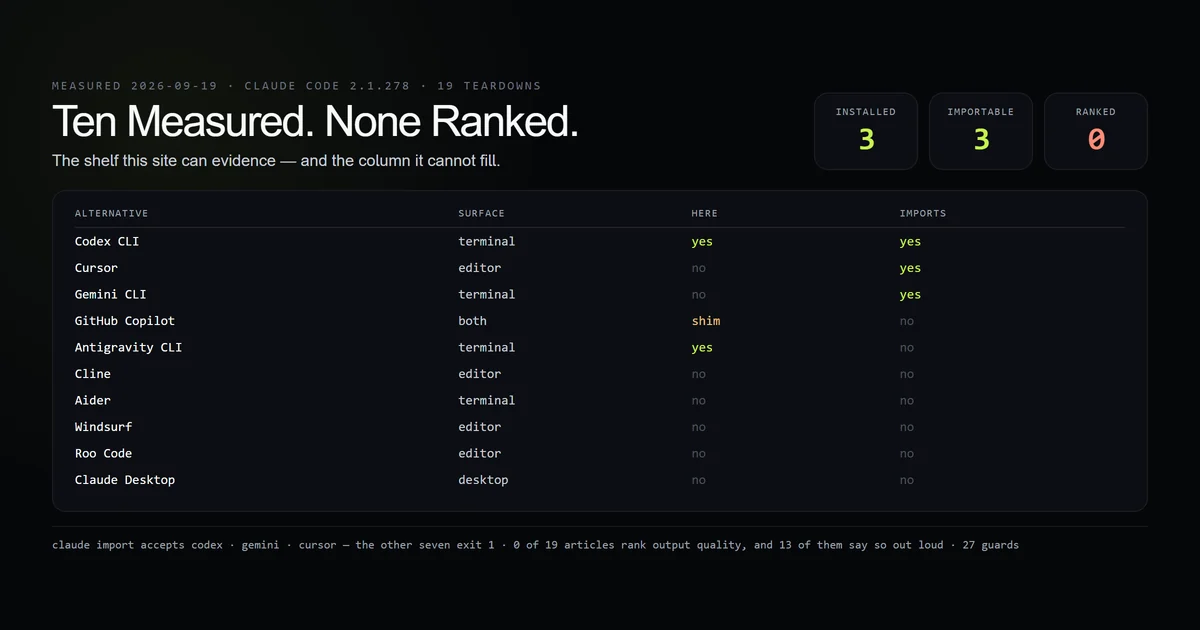
The best Claude Code alternative is whichever one survives the thing you are actually leaving — your instruction file, your MCP servers, your permission rules — and that is a question with a checkable answer. This site has published nineteen head-to-head teardowns covering ten alternatives. We pointed a script at our own corpus and at this laptop: three of the ten are installed here, three can import a Claude Code configuration, and zero are ranked by the quality of the code they write. Measured 2026-09-19 on CLI 2.1.278.
Key takeaways
- Ten alternatives, nineteen articles, zero output-quality rankings. Not one teardown in this corpus contains evidence for the ranking every "best alternative" list leads with.
claude importaccepts exactly three sources —codex,gemini,cursor. The other seven exit 1 with a usage line.- Three of the ten are installed on this machine, and one of those three is a command that cannot start its own CLI.
- Not one editor alternative is installed here. The VS Code extensions directory holds two agent extensions and both of them are Claude Code's.
- The evidence rots at different speeds. The newest row is a day old; the oldest is 36 days, which in this category is a historical document.
Best claude code alternative: what the evidence supports
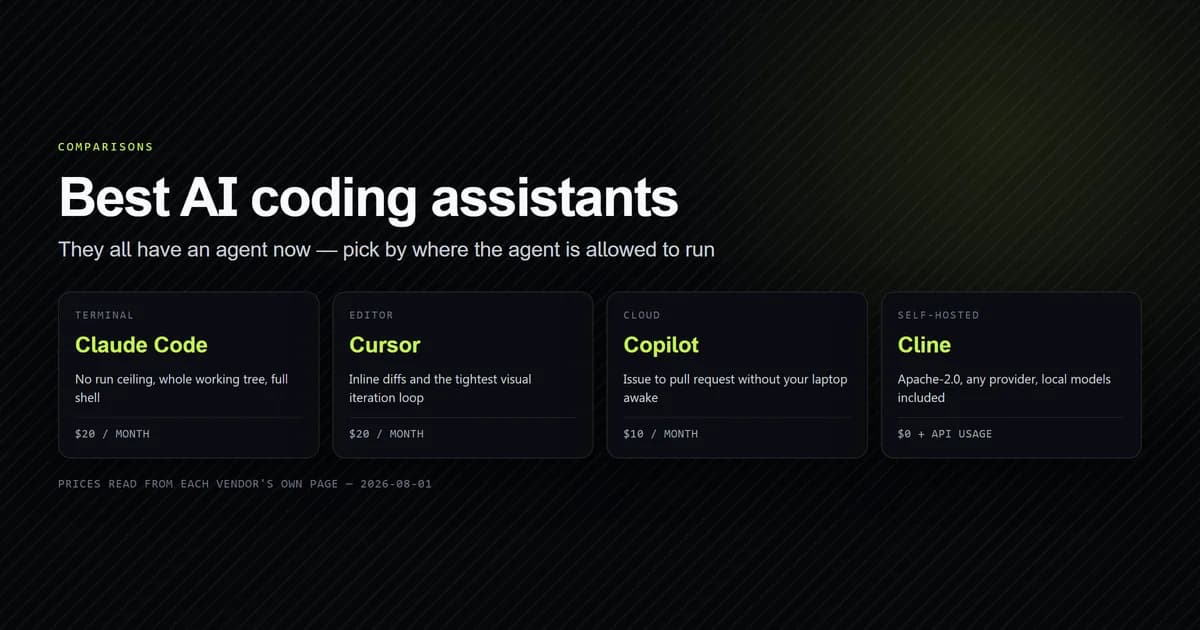
Start with what a shelf like this can honestly be built from. Our best AI coding assistants comparison is the pillar that ranks the field for somebody choosing a first tool. This article is for the opposite reader — you already run Claude Code, something about it is not working, and you want to know what the exit looks like.
For that reader the useful axes are not benchmark scores. They are: is the thing alive, is it installable, and does your configuration survive the move. All three are visible from outside the tool, which means you can check them yourself, and which is why every article behind this shelf measures them.
npm run check:alternatives
# → Installed on this machine   3 of 10 (Codex CLI, GitHub Copilot, Antigravity CLI)
# → Importable configuration    3 of 10 (Cursor, Codex CLI, Gemini CLI)
# → Ranked by output quality    0 of 10
# → Oldest evidence             Gemini CLI, 36 days
The script re-reads every article from content/ on each run, recomputes each row's age against today, and re-runs the importer live. When a row goes stale, the check says so before a reader does.
The shelf, and what each row cost to establish
Each row below is backed by articles on this site, not by a vendor page. The age column is recomputed on every check run, so it is older by the time you read it.
| Alternative | Last measured | Installed here |
|---|---|---|
| Cursor | 2026-09-16 | no |
| Codex CLI | 2026-09-17 | yes, on PATH |
| GitHub Copilot | 2026-09-18 | command present, CLI unreachable |
| Aider | 2026-09-17 | no |
| Cline | 2026-09-17 | no |
| Roo Code | 2026-09-18 | no |
| Antigravity CLI | 2026-09-18 | yes, on PATH |
| Windsurf | 2026-09-16 | no |
| Gemini CLI | 2026-08-14 | no |
| Claude Desktop | 2026-09-02 | no |
Two rows deserve a footnote rather than a cell. Roo Code is archived — last push 2026-05-15T18:08:47Z — and both extension registries still serve the package, which is why it stays on a shelf of things you can still install. Aider had gone 117 days without a push when we measured it, against cline/cline, openai/codex and anthropics/claude-code all pushing on the day of measurement; Aider's releases page is the primary source for that and it has not moved since.
Three of ten are installed on the machine that wrote this
The census is the part that surprised us. Of ten alternatives measured in nineteen articles, where finds three: codex, agy and copilot. And the third is the one our Copilot CLI comparison took apart — a 9,104-byte shim chain that searches for a CLI, does not find one, and offers to install it.
The editor side is emptier still. ~/.vscode/extensions holds exactly two agent extensions:
ls ~/.vscode/extensions
# → anthropic.claude-code-2.1.276-win32-x64
# → anthropic.claude-code-2.1.278-win32-x64
# → ritwickdey.liveserver-5.7.10
No Cline, no Roo Code, no Cursor, no Copilot Chat. Both agent extensions are Claude Code's, one version apart — the editor has kept the build our Cline comparison measured two days ago alongside the one installed since.
That matters for reading the rest of this site, and we would rather you heard it here: most of these teardowns were written with one side uninstalled. That is a real limit on what they can claim, and it is exactly why none of them claims capability.
Your configuration does not travel with you
This is the single most load-bearing measurement on the page, it costs nothing to re-run, and the check re-runs it every time:
claude import cline --dry-run
# → Usage: claude import [codex|gemini|cursor] [--dry-run] [--yes[=<digest>]]
# exit 1
Three sources in, seven refused. roo, cline, aider, antigravity, windsurf and copilot all exit 1 with that same line. And the three that are accepted are not symmetrical either: claude import gemini answers "No importable agent config found" on a machine where the Gemini CLI is not installed, so the accepted list is a statement about the importer, not about what will actually move.
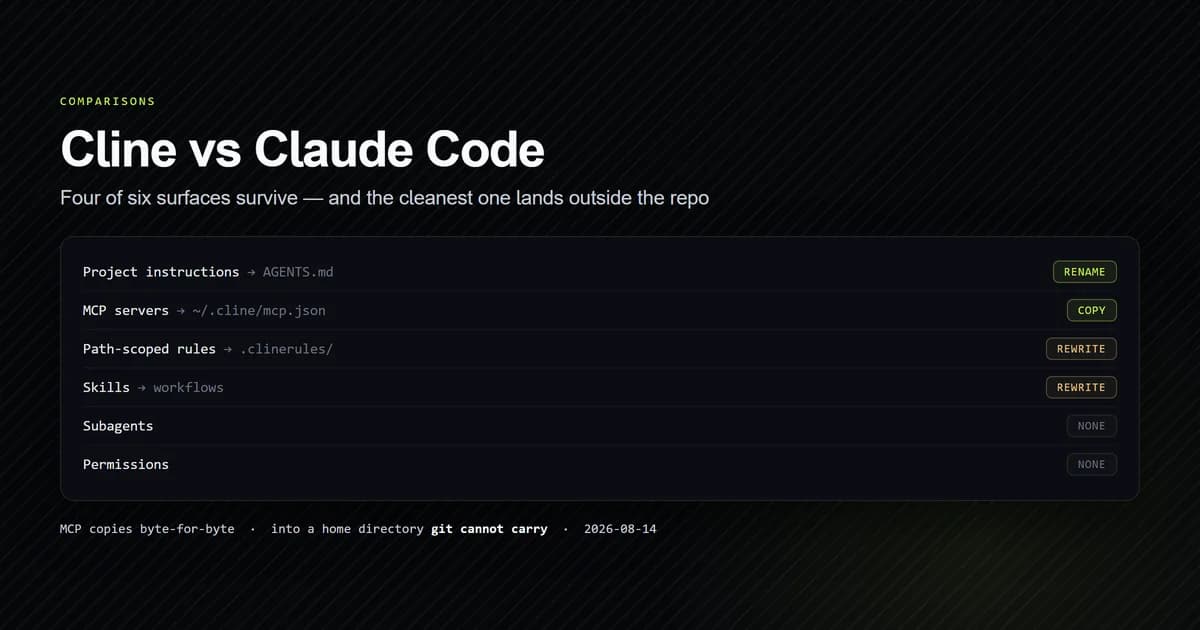
What does move is markdown. .roo/rules/ concatenates into a CLAUDE.md. An AGENTS.md you already keep costs nothing to leave in place. .mcp.json maps across as a project-scoped file. Everything past that — permission rules, hooks, subagent definitions, output styles — is per-tool and hand-carried, in both directions. What actually ports between Claude Code and Codex CLI is the fullest version of that audit, and its headline has not aged: 4 of 6 configuration surfaces present, 10,916 committed bytes, 0 bytes the other tool would read.
The ranking nobody publishes, including us
Here is the thing that did not work, and we went looking for it on purpose.
The article this was supposed to be ranks ten tools by how well they write code. Building that needs three things: a fixed task set, a grader, and every tool installed and authenticated. This corpus has none of the three — seven of the ten are not on this machine — so the ranking does not exist, and the honest version of this page says so in a heading instead of burying it in a closing caveat.
Then the script audited whether we had actually been saying it. Thirteen of the nineteen articles state the refusal in a sentence a reader can find. Six do not: our Claude Code vs Cursor, GitHub Copilot vs Claude Code, Cursor vs Windsurf vs Cline, RooCode vs Claude Code, Claude Code vs Claude Desktop and Claude Code vs Aider 2026 comparisons. None of them makes a quality claim either — but not making a claim and declining to make one read differently, and the second is what a reader can verify. Claude Desktop is the weakest row on the shelf for exactly this reason: it rests on a single article that never raises the question at all.
That gap was found by this site's own check pointed at this site's own corpus, which is the only reason it is in the article rather than in a reader's email.
| What a ranking needs | What this corpus has |
|---|---|
| A fixed task set | none |
| A grader | none |
| Every tool installed | 3 of 10 |
So treat any "best Claude Code alternative" list that leads with a quality verdict as a claim about the author's confidence rather than about the tools. Ask which tools they had installed. The answer is usually one.
Claude code competitors sorted by what you are leaving
The useful question is not which tool is best. It is which constraint made you look, because that picks the exit for you.
- You are leaving on cost. Stay and change the model first. The premium between tiers is 2.19x on a real coding task, and the harness moves your bill more than the tool badge does. Switching agents to save money usually swaps one metered API for another.
- You are leaving for an editor. Cline. It is the upstream of the archived fork most people land on, it was pushed the day we measured it, and it is the largest of that lineage by a wide margin. Its CLI 2.0 announcement is the primary source for where the project is heading.
- You are leaving for another terminal agent. Codex CLI. It is the only row that is both installed here and importable, which makes the switch something you can test in an afternoon rather than plan. Budget for the 32,768-byte instruction ceiling.
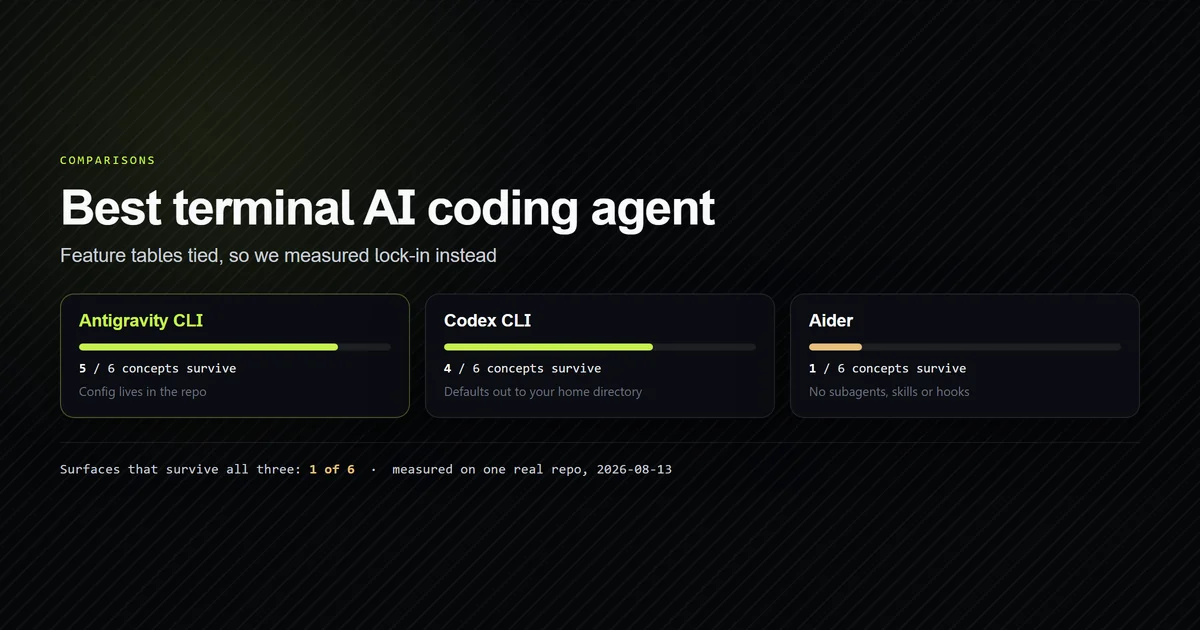
- You want a different vendor's model in the same shape. Antigravity CLI serves 14 models across three vendors, two of them Anthropic's — but on 2026-09-18 it loaded no instruction file at all across six arms, so everything your repository tells an agent, you will be re-telling by hand.
- You want something similar to Claude Code without a terminal. Claude Desktop, with the difference priced rather than described. This is the row we would most like more evidence for.
- You are leaving because it is not maintained. Then you are not on Claude Code. That is Roo Code's reader, and the answer is Cline or Kilo Code.
What we could not measure
Which one writes better code. Stated above, stated in thirteen of the nineteen sources, and worth stating once more because it is the thing you came for.
Whether these are the ten that matter. The roster is what this site has measured, not a survey of the field. opencode, Goose, Continue and Kilo Code are named nowhere on this shelf, and three of those have been on our list of topics to cover for a month.
What anybody else's machine looks like. Seven of ten uninstalled is a fact about one Windows laptop. A reader running Cursor as their editor would produce a different census and the same importer result.
Whether the tools we could not install would have changed the ranking, because there is no ranking. The three that are installed were later pointed at one committed task, and only one of them completed it — a different gap from the one this shelf measures, and a more practical one. That is not a dodge — it is the reason the refusal is load-bearing rather than decorative.
How many of those 3,422 Roo Code forks carry post-archive commits. We counted the forks and did not audit them, which is the measurement that would show whether the code moved on rather than stopped.
Common mistakes
- Reading a vendor comparison table as evidence. It is a specification, written by one of the parties. Ask what was installed.
- Assuming an importer exists because two tools look alike. Seven of ten exit 1. Check before you plan the migration, not after.
- Treating "reads
AGENTS.md" as a yes/no. It has at least three answers: in full, truncated at 32,768 bytes, and not at all — and we have measured a tool in each category. - Switching agents to fix a cost problem. Measure your own turn shape first. The model is a multiplier on a bill your harness assembles.
- Trusting a comparison without a date. Every row on this shelf has one, and the oldest is 36 days. In this category that is old.
Conclusion
If you are leaving Claude Code today, the shortlist this evidence supports is short: Codex CLI if you want to stay in a terminal, Cline if you want an editor. Both are alive, one is importable, and neither recommendation rests on a quality claim — because we do not have one and neither does anyone else who has not installed all ten. Our internal check script stands behind the table; it recomputes every age and re-runs the importer, and it will go red before this page goes wrong. Then read what actually transfers between the two terminal agents, because that is the migration you are really planning.
Frequently asked questions
What is the best Claude Code alternative in 2026?
Are there tools similar to Claude Code that read the same config files?
Which Claude Code competitors are actually still maintained?
Can I move my CLAUDE.md to another tool?
Why does this article not rank the tools by how good their output is?

Muhammad Kashif
Founder and editor of Devventa, covering AI coding assistants, Next.js and the modern AI development stack.