Yes. Claude plan mode uses tokens in three separate ways, and the one most people miss bills a second model you never selected. Planning turns carry your full transcript on every request, extended thinking bills as output, and a classifier reviews shell commands while you plan. This guide breaks down each cost, names the settings that change it, and gives the decision rule for when planning is still cheaper than the rework it prevents. Checked against Claude Code v2.1.223 and Anthropic's cost documentation in August 2026.
Key takeaways
- Plan mode has three distinct token costs, not one: the planning turns, extended thinking, and the auto mode classifier.
- The classifier runs on Claude Sonnet 5 by default rather than your
/modelselection, so planning can bill a model you did not choose. - Reads and working-directory edits skip the classifier entirely. The overhead concentrates on shell commands and network operations.
- Anthropic's own cost guidance recommends plan mode to reduce spend. Both things are true at once, and the deciding factor is the cost of being wrong.
showClearContextOnPlanAcceptstops research tokens from riding into execution. It is off by default.
Does Claude plan mode use tokens
Plan mode is a permission mode, not a billing mode. Nothing about it is free, and nothing about it is metered separately. Claude reads files, runs read-only commands, and writes a proposal, and every one of those actions is an ordinary API request charged at ordinary rates.
The confusion comes from what plan mode blocks. Because it prevents edits, it reads as a lighter, cheaper mode than one where Claude is actively writing files. That intuition is wrong in both directions: exploration can be more expensive than the edit it precedes, and the edit is often the cheapest part of the whole exchange.
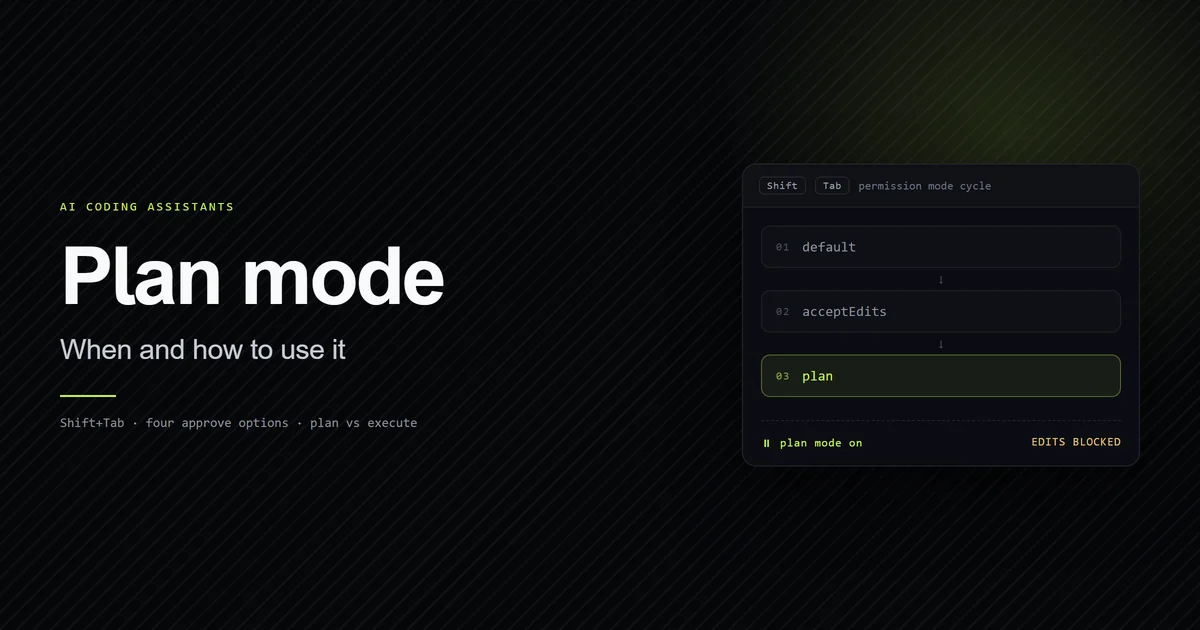
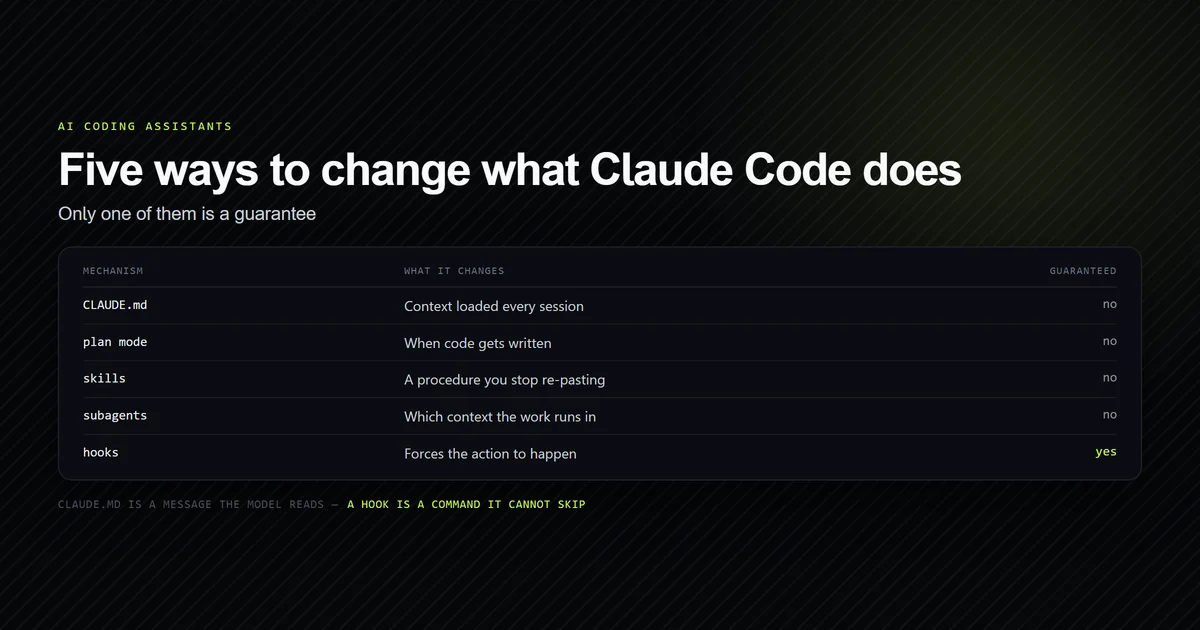
If you want the mechanics of the mode itself rather than its cost, start with Claude Code plan mode, and see the complete Claude Code guide for where planning sits against the rest of the tool.
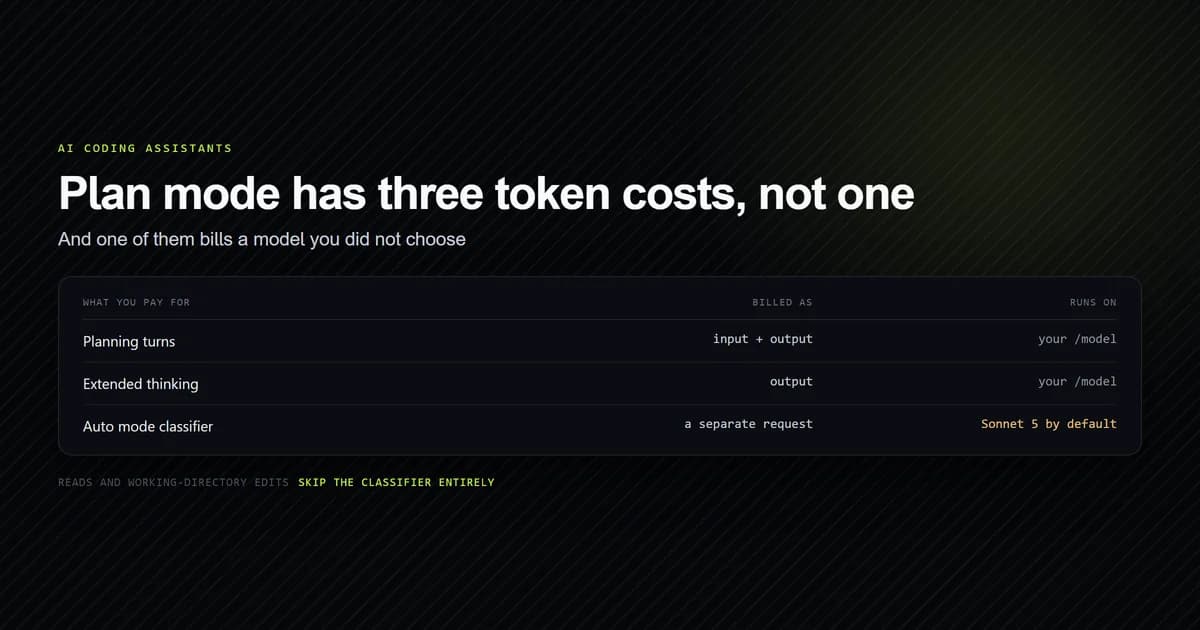
The three token costs of planning
| Cost | What drives it | Billed as |
|---|---|---|
| Planning turns | Full transcript resent per request, plus file contents read | Input, at cached rates where the prefix matches |
| Extended thinking | On by default, sized to task complexity | Output |
| Classifier checks | One round-trip per shell or network action | Input and output on a second model |
The planning turns. Claude Code sends your full conversation with every request, and each tool use sends another request carrying that batch of results. A research pass that reads eleven files does not cost eleven file reads. It costs eleven files, resent on every subsequent turn in the session, which is why a long planning session raises the price of everything that follows it.
Prompt caching absorbs much of this. Per Anthropic's prompt caching documentation, Anthropic documents a one-hour cache lifetime on a subscription, dropping to five minutes once you draw on usage credits, and five minutes by default on an API key or cloud provider. That gap matters more than it sounds: a plan you leave open over lunch reprocesses your entire context on the next message.
Extended thinking. Thinking is enabled by default because it measurably improves planning and reasoning, which is exactly what plan mode is for. Thinking tokens bill as output tokens, and Anthropic's cost documentation puts the default budget at "tens of thousands of tokens per request depending on the model." Planning is the workload that benefits most from thinking and therefore the workload that spends most on it.
The classifier is the cost nobody counts
This is the part that surprises people, and it is the reason the honest answer to the title question is "more than you think."
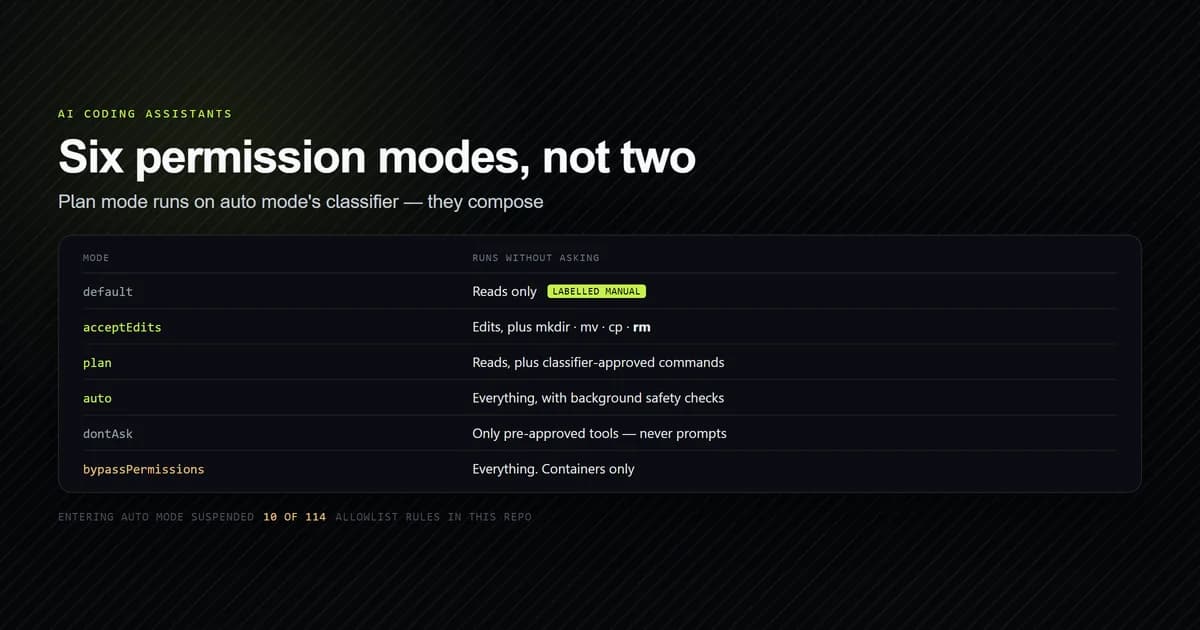
When auto mode is available to your account and the useAutoModeDuringPlan setting is on, which
it is by default, a classifier reviews shell commands during planning instead of prompting you.
Anthropic states the cost plainly: "Classifier calls count toward your token usage. Each check
sends a portion of the transcript plus the pending action, adding a round-trip before execution."
Two details make this larger than it first appears.
- It is a second model. The classifier runs on Claude Sonnet 5 by default rather than on your
/modelselection. If you deliberately picked a cheaper model for a session, planning can still route classifier checks to Sonnet 5. - It carries transcript. Each check sends a portion of the conversation, not just the command, so the checks get more expensive as the planning session grows.
The scope limit is the good news. Reads and working-directory edits outside protected paths skip the classifier, so a planning session that only reads files never triggers it. The overhead concentrates on shell commands and network operations, which is precisely what a thorough research pass tends to run.
If your account cannot use auto mode at all, none of this applies and commands outside the built-in read-only set prompt you instead. That is the cheaper path in tokens and the more expensive one in attention. The relationship between the two modes is covered in auto mode versus plan mode.
When planning still saves money
In Anthropic's cost documentation, Anthropic recommends plan mode as a way to reduce token usage, listing it under strategies for working efficiently on complex tasks: it prevents "expensive re-work when the initial direction is wrong."
That is not a contradiction of everything above. Both are true, and the resolution is a single question: what does being wrong cost here?
| Planning is cheaper | Editing directly is cheaper |
|---|---|
| You do not know which files are involved | You know the file and the change |
| The change crosses a boundary or shared type | The change is local and reversible |
| Several approaches exist and they diverge | One obvious approach |
| Redoing it means undoing migrations or schema | Redoing it means one git checkout |
The asymmetry is the whole argument. A research pass costs a bounded number of tokens you can estimate in advance. Implementing the wrong design costs the implementation, the discovery that it is wrong, the revert, and then the right implementation, on top of a context window now full of the abandoned attempt. Planning is insurance, and the premium is worth paying exactly when the claim would be large.
For how this fits your broader spend, see what AI coding assistants actually cost.
Ultraplan and agent teams
Two features change the arithmetic enough to be worth naming separately.
Ultraplan moves planning to a Claude Code on the web session rather than your terminal. Your CLI shows a status indicator while it drafts and your terminal stays free. The tokens are still spent; what changes is where the context lives. When the draft comes back you choose whether it executes in the cloud or teleports to your terminal, and one of those options starts a fresh session carrying only the plan. That last choice is a genuine saving, because it drops the research context rather than carrying it into implementation.
Agent teams move the number in the wrong direction. According to Anthropic's agent teams documentation, agent teams "use approximately 7x more tokens than standard sessions when teammates run in plan
mode, because each teammate maintains its own context window and runs as a separate Claude
instance." Teams are disabled by default and need CLAUDE_CODE_EXPERIMENTAL_AGENT_TEAMS=1 to
enable, so this is opt-in rather than a cost you can hit by accident.
Best practices
- Turn on
showClearContextOnPlanAccept. It adds an approval option that accepts the plan and clears the planning context together. Research turns are exactly the tokens you do not want carried into execution, and this is the only control that drops them at the boundary.
{
  "showClearContextOnPlanAccept": true
}
- Lower effort for shallow planning. A plan for a well-understood refactor does not need
maximum reasoning depth.
/effortcosts one keystroke and changes the largest output-token line item. - Plan once, then clear. A session that has planned, executed, and moved to unrelated work is
carrying dead research context on every request.
/clearcosts nothing; compaction costs a large request. - Watch the attribution panel. On a Pro, Max, Team, or Enterprise plan,
/usagebreaks recent usage down by skills, subagents, plugins, and MCP servers, and flags any behavior accounting for 10% or more of it. - Keep planning sessions short. Classifier checks carry a portion of the transcript, so their cost grows with the conversation. A tight research pass is cheaper per check than a sprawling one.
Common mistakes
- Assuming plan mode is a cheap mode because it blocks edits. The blocking has nothing to do with billing. Exploration is frequently more expensive than the edit it precedes.
- Planning things you already understand. This is the single most common way to waste tokens on planning. Insurance on a change you could make in one turn is pure overhead.
- Forgetting the classifier is a second model. Selecting a cheaper model with
/modeldoes not move classifier checks to it. They default to Sonnet 5 regardless. - Leaving a planning session open across a break. On a subscription the cache lifetime is an hour, and on an API key it is five minutes. The first message after that window reprocesses the full context at uncached rates.
- Carrying research context into execution. Without
showClearContextOnPlanAccept, every file Claude read while planning is resent with every implementation request for the rest of the session.
Conclusion
Use plan mode when the cost of the wrong approach exceeds the cost of an extra turn, and turn on
showClearContextOnPlanAccept so the research does not follow you into implementation. Skip it for
changes you have made before. If you are trying to reduce spend specifically, the largest levers
are effort level and session hygiene rather than avoiding plan mode, because the rework it prevents
is usually larger than the tokens it costs. For the mode's mechanics see
plan mode, for why token accumulation triggers session lockouts see
AI coding rate limits, and for how the tools compare on price,
AI coding tools pricing comparison.
Frequently asked questions
Does plan mode cost more than just making the edit?
Does plan mode use tokens even when Claude only reads files?
Which model does the auto mode classifier run on?
How do I stop plan mode from carrying research tokens into execution?
Do agent teams change plan mode token costs?

Muhammad Kashif
Founder and editor of Devventa, covering AI coding assistants, Next.js and the modern AI development stack.