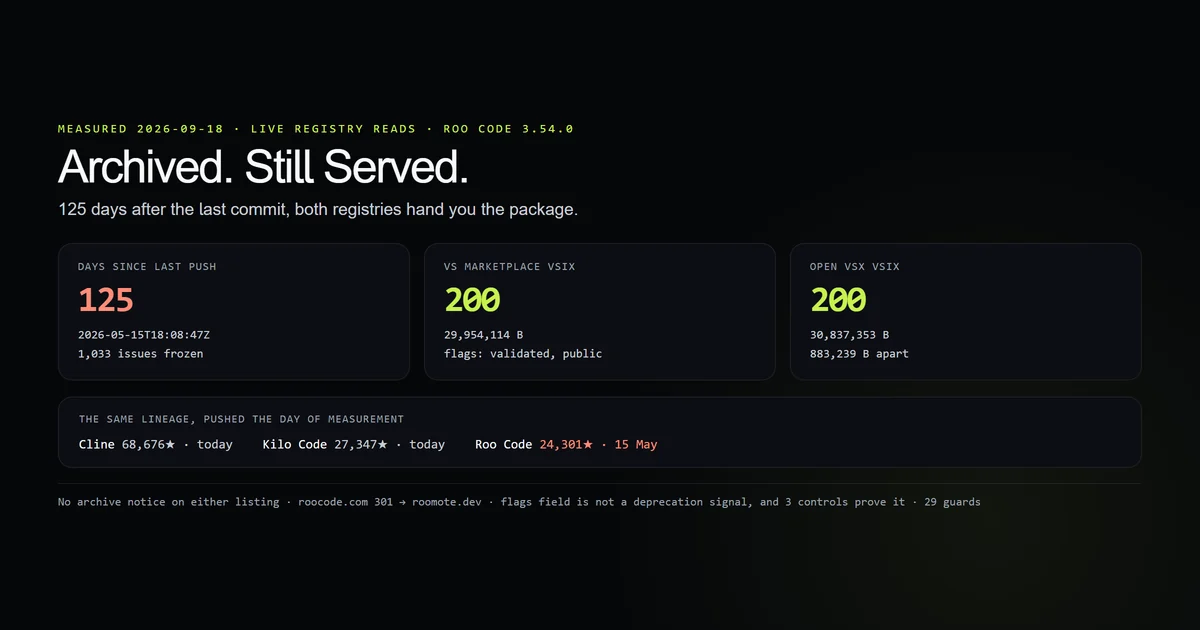
Claude code vs roocode is a comparison against a build that stopped moving on 15 May 2026. This site said so in August. What we did not check then, and check here, is whether anything downstream noticed: 125 days after the final commit, both extension registries still serve version 3.54.0, both still return the package itself on request, and neither listing says a word about it. Roo Code is archived and installable at the same time. Our best AI coding assistant comparison covers what to run instead; this measures what is still being handed out.
Key takeaways
RooCodeInc/Roo-Codeis archived, last push2026-05-15T18:08:47Z— 125 days before measurement, with 1,033 issues frozen.- Both registries returned HTTP 200 and the real VSIX: 29,954,114 bytes from the Microsoft gallery, 30,837,353 from Open VSX.
- The marketplace listing still reads "A whole dev team of AI agents in your editor" and the
mainREADME carries no archive notice. - We tried to use the gallery's
flagsfield as a deprecation signal. Three extensions dead for one to seven years return identical flags. It is not a signal. - Kilo Code, the living fork, now has 27,347 stars against Roo's frozen 24,301.
Claude code vs roocode: comparing against a frozen build
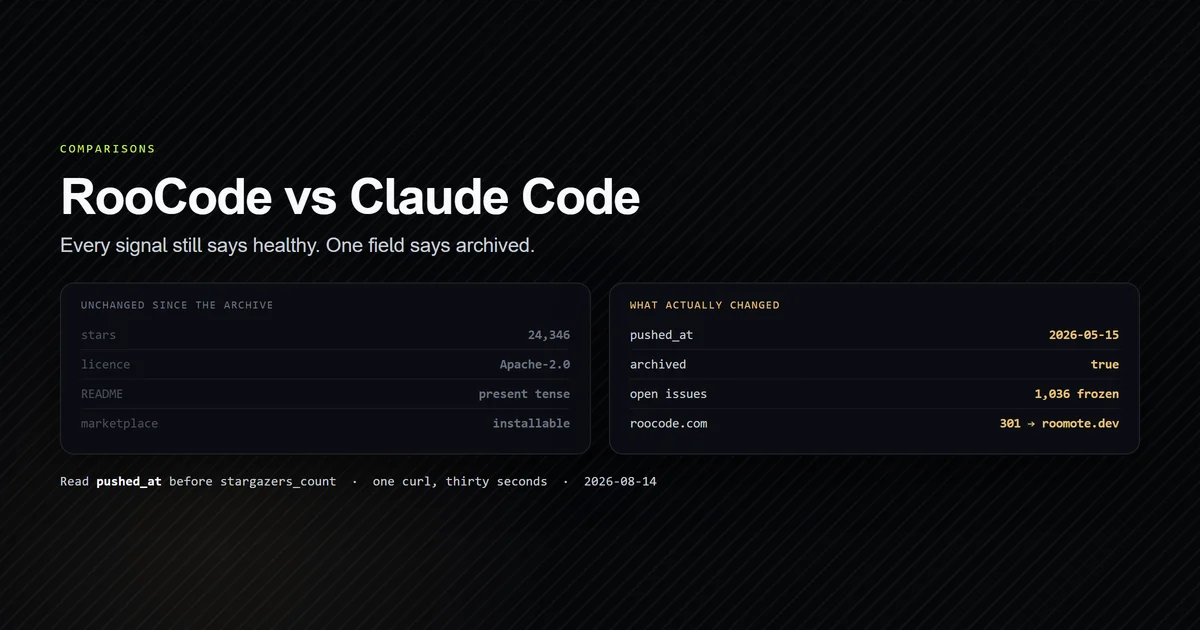
RooCode vs Claude Code: The Comparison Closed in May established the archive on 2026-08-14 and covered the portability question — what to carry out of a .roo/ repository and where to put it. That article is the migration guide, and its conclusions are unchanged.
This one asks a narrower question that only gets interesting with time: an archived project's code stops, but its distribution does not necessarily stop with it. Four months is long enough to find out. Everything below is a public registry response or a GitHub API field, so npm run check:roo-dist re-reads all of it live on every run from any machine — including the ones that will go red the day this stops being true.
125 days, two registries, still 200
The archive is not ambiguous. archived: true, and the final push is stamped eight minutes after the final release was published.
| Field | Value |
|---|---|
| Last push | 2026-05-15T18:08:47Z |
| Days since | 125 |
| Latest release | v3.54.0, 2026-05-15T17:52:24Z |
| Open issues, frozen | 1,033 |
| Forks | 3,422 |
| Licence | Apache-2.0 |
The distribution side is where it diverges. Both registries answer as if nothing happened:
npm run check:roo-dist
# → LIVE gallery   v3.54.0 flags="validated, public" installs=2,016,567
# → LIVE open-vsx  v3.54.0 downloads=1,958,865
# → LIVE vsix      200 29,954,114 B
# → LIVE redirect  roocode.com 301 -> https://roomote.dev/
That 200 is the load-bearing number. We did not check that a listing page exists — we requested the package, and 29,954,114 bytes came back. A fresh install of Roo Code today is one click, and the click works.
One version, two different files
A detail we did not expect. The Microsoft gallery and Open VSX both serve 3.54.0, and the two packages are 883,239 bytes apart:
| Registry | Version | VSIX bytes |
|---|---|---|
| Visual Studio Marketplace | 3.54.0 | 29,954,114 |
| Open VSX | 3.54.0 | 30,837,353 |
The timestamps differ too — Open VSX stamped 17:52:22Z, the gallery 17:59:40Z, about seven minutes apart on the last day the project shipped. So "Roo Code 3.54.0" names two artifacts, not one, and if you are pinning a version for a team you should pin the registry as well. We did not unpack either package to find where the difference lives, and we do not speculate.
The counter that went backwards
We read the marketplace install counter three times within an hour:
- 2,015,281
- 2,015,090
- 2,016,567
The second read is 191 lower than the first. A counter that decreases is a sharded estimate, not a ledger, so the honest statement is a range: Roo Code sits at roughly 2.0 million marketplace installs plus 1,958,865 Open VSX downloads, near four million between them, and the movement between reads is noise rather than growth.
We flag it because the tempting version of this article says "people are still installing it, the counter is rising." We cannot support that from three reads with a decrease in the middle, so we do not say it. What we can say is that the packages are still served and the counters are still being written to.
The signal we went looking for and did not find
Here is the thing that did not work. The gallery response carries a flags field, and Roo Code's reads validated, public. The obvious article writes itself: no deprecation flag, four months after the archive.
So we checked the field against extensions that have been dead far longer:
| Extension | Last updated | Flags |
|---|---|---|
| Roo Code | 2026-05-15 | validated, public |
TSLint (ms-vscode) | 2022-03-31 | validated, public |
Beautify (HookyQR) | 2019-05-03 | validated, public |
Azure Account (ms-vscode) | 2025-01-22 | validated, public |
Three extensions abandoned for between one and seven years return exactly what Roo Code returns. The field carries no deprecation signal in this API, so it cannot be evidence of one, and the article does not use it as such. The check script keeps all three controls so nobody rebuilds that argument later.
What survives is weaker and still true, because it is about copy rather than metadata: the listing's own description is "A whole dev team of AI agents in your editor." — present tense — and the README on main opens with the tagline "Your AI-Powered Dev Team, Right in Your Editor" and a marketplace badge, with no archive notice anywhere in it. GitHub's own banner on the repository page is the only place a visitor is told.
Where roo cline actually went
Roo Code was a Cline fork and never dropped the evidence — its extension id is still RooVeterinaryInc.roo-cline, which is why "roo cline" is what a lot of people still search. Both ends of that lineage are alive; the middle is not.
| Project | Stars | Last push | Marketplace installs |
|---|---|---|---|
| Cline (upstream) | 68,676 | 2026-09-18 | 5,362,384 |
| Kilo Code (fork) | 27,347 | 2026-09-18 | 1,547,372 |
| Roo Code | 24,301 | 2026-05-15 | ~2,015,000 |
Kilo Code now carries more GitHub stars than the archived project it descends from, and both living repositories were pushed on the day of this measurement — one at 13:32Z, the other at 15:09Z. Cline is where we measured the VS Code agent comparison on 2026-09-17, and it remains the largest of the three by a wide margin.
The domain tells the other half. roocode.com still 301s to roomote.dev, a cloud agent product. Its homepage mentions Roo Code exactly once — inside a customer testimonial, as a thing the speaker used to try — and carries no migration notice and no mention of the archive. That is the same finding this site recorded in August, still standing four months on, now with a count attached.
What Claude Code will not do for you
Claude Code's importer does not help here, and it is worth being exact about which sources it takes:
claude import roocode --dry-run
# → Usage: claude import [codex|gemini|cursor] [--dry-run] [--yes[=<digest>]]
# exit 1
roo fails the same way. So does cline, which matters more than it looks: if you are leaving Roo for its still-maintained upstream, no tooling moves your configuration in that direction either. The migration is manual in every direction, and the original comparison has the mapping — .roo/rules/ is plain markdown that concatenates into a CLAUDE.md, .roo/mcp.json maps onto a project-scoped .mcp.json, and an AGENTS.md you already have costs nothing to keep.
Roocode or Claude Code: which to run
- You are choosing today. Claude Code, or Cline, or Kilo Code — anything with a commit this quarter. A 125-day-old build is not a shortlist entry.
- You already run Roo Code and it works. It will keep working; nothing is being pulled. Budget for the day a VS Code API change breaks it, because no one will ship the fix.
- You want the closest thing to Roo, maintained. Kilo Code. It descends from the same code, it is MIT rather than Apache-2.0, and it shipped today.
- You want the upstream. Cline, the project Roo forked from — the largest of the three, and the one this site measured against Claude Code in September.
- You are pinning a version for a team. Pin the registry too. The two copies of 3.54.0 differ by 883,239 bytes.
What we could not measure
Whether anyone is still installing it. Three reads of the install counter gave three values, one of them lower than the read before. We can show the package is served; we cannot show demand.
Why the two VSIX files differ. We compared content lengths, not contents. The 883,239-byte gap is real and unexplained here.
What the registries intend. Neither Microsoft nor Open VSX publishes a rule about archived-upstream extensions that we tested. The absence of a notice is an observation about what a user sees, not a claim about policy.
Anything about how Roo Code performs. It is not installed on this machine and was never run. No output-quality, latency or cost comparison appears in this article, and the fixture asserts that through a guard.
The fork count is a number, not a plan. 3,422 forks exist. We did not measure how many have commits after the archive date, which is the question that would actually tell you whether the code is being carried forward.
Common mistakes
- Reading "archived" as "gone." It is archived and installable. Those are different systems, and only one of them was updated.
- Trusting a marketplace listing to tell you. The copy is present tense and the flags are identical to extensions dead since 2019.
- Assuming the redirect is a migration.
roocode.compoints at a different product that does not mention the archive. - Treating
roo-clineas Cline. The id is a fork artifact. Cline is upstream, alive, and three times the size. - Waiting for an importer.
claude import roo,roocodeandclineall exit 1. Nothing is coming.
Conclusion
For claude code vs roocode, there is no live comparison to make — one side stopped on 15 May and the other shipped a build the week you are reading this. The decision is not which to pick but how quickly to leave, and the answer is: before a VS Code API change makes it for you. Move .roo/rules/ into a CLAUDE.md, keep your AGENTS.md, and expect to do it by hand. Then read what the upstream looks like today, because Cline is where most of this code actually went.
Frequently asked questions
Is Roo Code still maintained in 2026?
Can you still install Roo Code?
What replaced Roo Code?
What is the difference between roo cline and Cline?
Can Claude Code import my Roo Code configuration?
Muhammad Kashif
Founder and editor of Devventa, covering AI coding assistants, Next.js and the modern AI development stack.