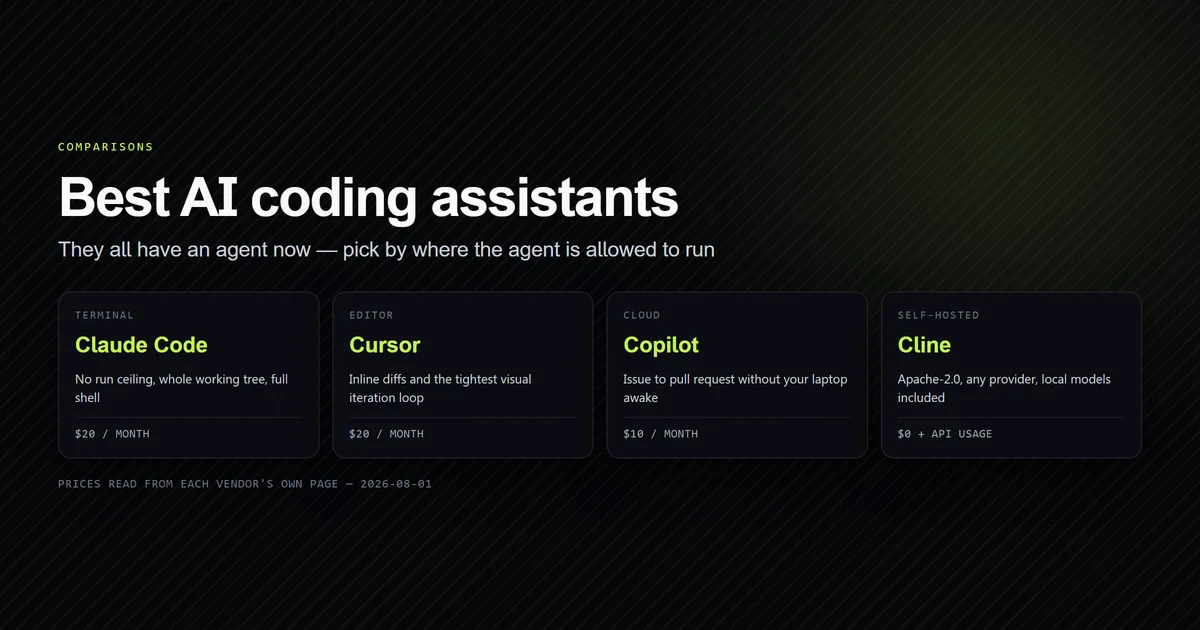
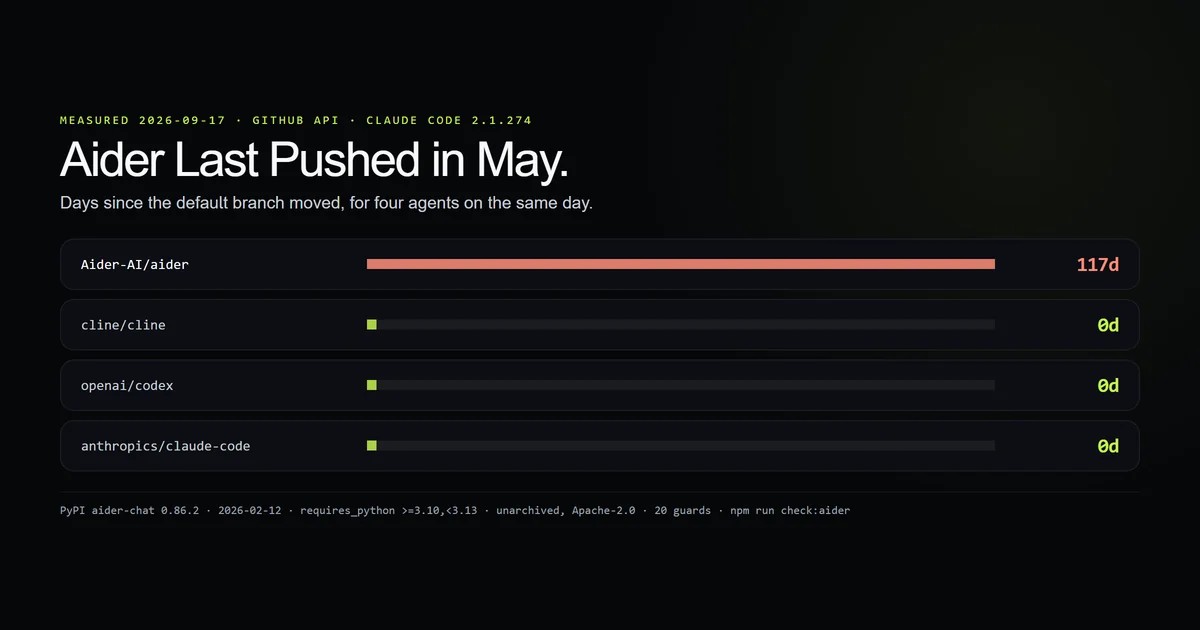
Claude code vs aider 2026 is a different question from the one people asked in 2025, and the reason is a date. On 2026-09-17 we queried four repositories through the GitHub API: cline/cline, openai/codex and anthropics/claude-code had all pushed within hours. Aider-AI/aider last pushed on 2026-05-22 — 117 days earlier. Nothing is archived, nothing announced an ending, and aider.chat still answers 200. Aider is dormant, not dead, and that distinction decides which of the two you should run. Our best AI coding assistant comparison ranks the wider field; this one answers the 2026 version of one pairing.
Key takeaways
- Aider's default branch has not moved in 117 days; the three agents it competes with pushed on the day of measurement.
- The last three commits on that branch expand an
ANTHROPIC_MODELSlist with new Claude model names. - PyPI serves
aider-chat0.86.2 from 2026-02-12; the newest tagged GitHub release is v0.86.0 from 2025-08-09. requires_pythonis pinned>=3.10,<3.13, so Aider will not install on a current interpreter.- Aider is Apache-2.0.
anthropics/claude-codepublishes no SPDX licence at all — the one axis where Aider still wins outright.
Claude code vs aider 2026: what changed
Nothing about Aider's design changed. What changed is the release cadence around it, and cadence is the only variable that moves in a field where the feature lists converged eighteen months ago.
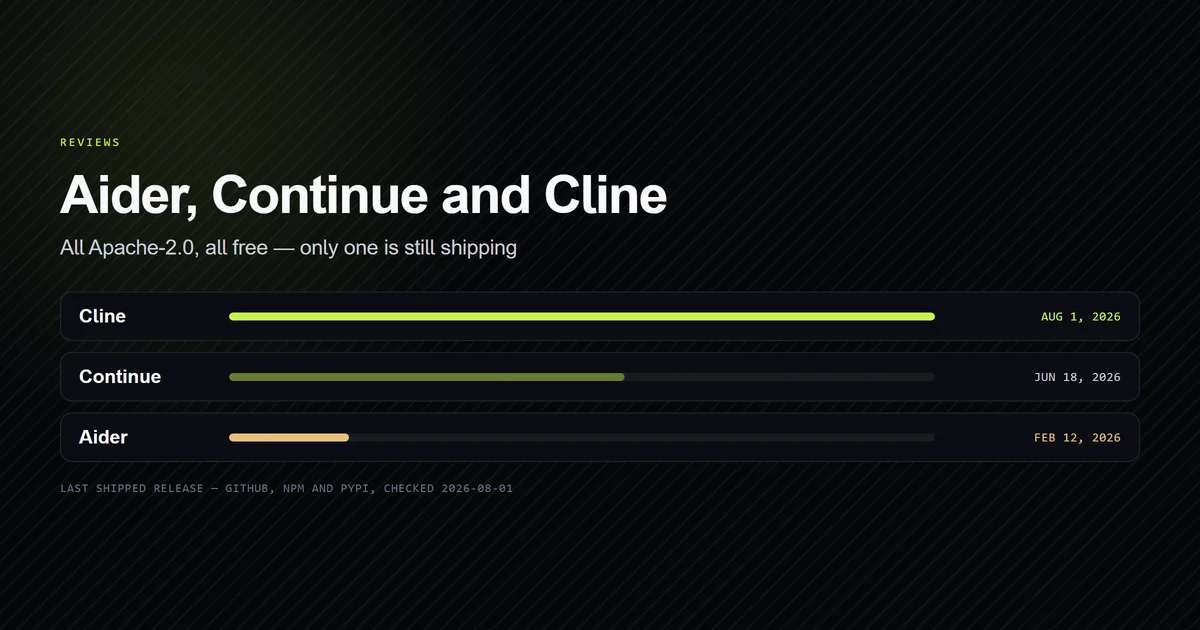
We first recorded the slowdown on 2026-08-26, in our survey of open source AI coding assistants, at two and a half months since the last commit and with the verdict "slowed rather than dead". Three weeks later the same commit is still the last one, the gap is four months, and the comparison set has moved on without it. This article is that interval measured against the field rather than against Aider alone.
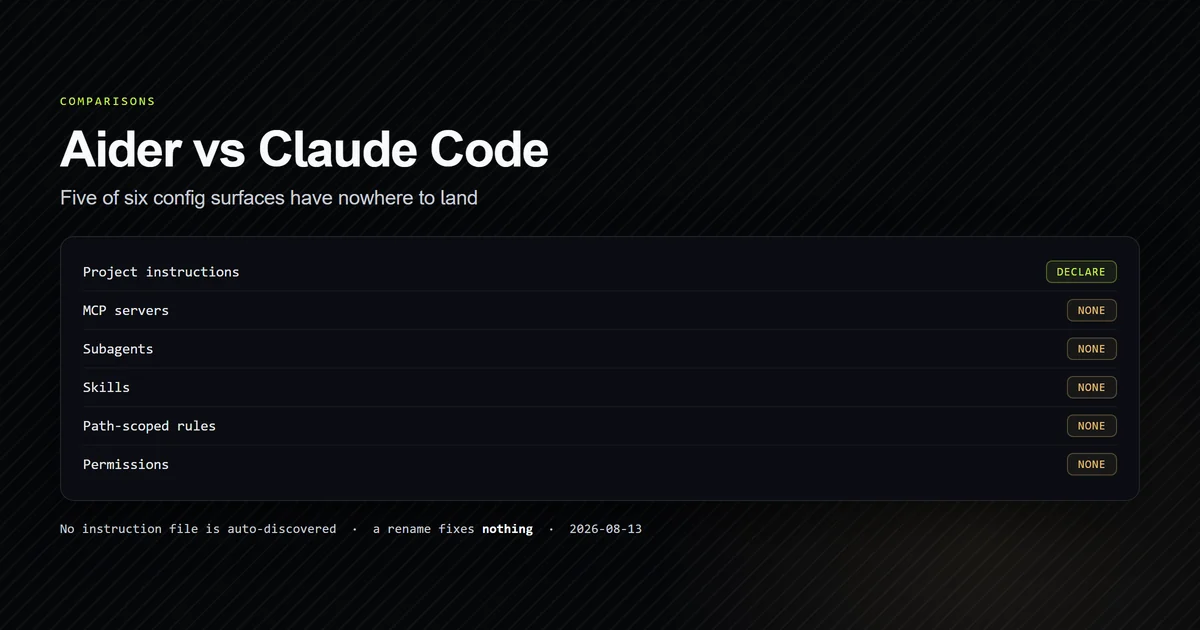
Our earlier audit, Aider vs Claude Code: Fewer Surfaces, Fewer Locks, scored the two on configuration scope and found 1 of 6 surfaces survives the move. That finding is still correct and this article does not re-run it. The 2026 question sits on top of it: if the surfaces you give up are also the surfaces still being built, the trade is not the one that audit priced.
The activity check, run live
Four GET /repos/{owner}/{repo} calls, run on 2026-09-17 and re-run by the check script on every invocation.
| Repository | Last push | Licence |
|---|---|---|
Aider-AI/aider | 2026-05-22 | Apache-2.0 |
cline/cline | 2026-09-17 | Apache-2.0 |
openai/codex | 2026-09-17 | Apache-2.0 |
anthropics/claude-code | 2026-09-17 | none published |
npm run check:aider
# → Aider-AI/aider           pushed 2026-05-22T14:02:20Z    118d ago (now)  Apache-2.0
# → cline/cline              pushed 2026-09-17T18:49:07Z      0d ago (now)  Apache-2.0
The guard on that row is written as a floor rather than an equality — daysSincePush >= 117 — so it stays green while Aider is quiet and goes red the day somebody lands a commit. That is the right shape for this claim. The only news that falsifies this article is good news, and we would rather find out from a failing check than from a reader.
The commits themselves are worth reading. The last three on the default branch are 2ec3550 "Expand ANTHROPIC_MODELS list with recent Claude model names", a7a54a9 "Apply ANTHROPIC_MODELS expansion", and the merge that landed them. Aider's final recorded work was keeping up with Anthropic's model names.
The release trail is older than the commits
Two registries disagree about what "latest" means, and both are older than the branch.
- PyPI serves
aider-chat0.86.2, uploaded 2026-02-12 — 216 days before measurement. - GitHub releases stops at v0.86.0, published 2025-08-09 — 403 days.
- The gap between the last two PyPI uploads is 182 days. 0.86.1 landed 2025-08-13; 0.86.2 landed six months later.
174 releases sit behind that number, so this is a project that shipped constantly and then stopped, not one that never had a cadence. If you are quoting an Aider version in a comparison, quote the PyPI one and date it — the GitHub releases page is over a year behind the package index.
A registry serving a stopped project is the rule rather than the exception. Roo Code has been archived outright since May and both extension registries still return its 30 MB package with no notice — so a working install button tells you nothing about whether anyone is still shipping.
Aider or claude code: what you actually install
This is where the 2026 answer diverges most sharply from the 2025 one, and it is measurable on a machine rather than argued.
The aider-chat package pins requires_python to >=3.10,<3.13. That upper bound is exclusive, so a machine on 3.13 or newer needs a second interpreter before pip install aider-chat will resolve at all. On the machine this site is built on there is no Python on the Windows side — python and python3 both resolve to the Microsoft Store App Execution Alias stub, which prints an install advertisement and exits. The WSL half has 3.12.3, which satisfies the pin.
That sounds like a footnote and is not. Our own repository's toolchain is Windows-native — node_modules holds Windows binaries, so npm run build fails from WSL on lightningcss.linux-x64-gnu.node. The half of this machine that can run Aider is the half that cannot build the project Aider would be editing. Claude Code ships a single native binary per platform and has no runtime to satisfy.
Neither tool imports the other, either. claude import aider exits 1 on 2.1.274:
claude import aider --dry-run
# → Usage: claude import [codex|gemini|cursor] [--dry-run] [--yes[=<digest>]]
# → exit 1
We found the same refusal for cline, copilot and windsurf when we audited the importer against a renamed product; three supported sources is the whole list, and it has not grown.
Aider is still the open source agent Claude Code is not
Here is where the comparison turns, and it is why this article does not end at the activity table.
Search open source agent and Aider is still a correct answer. It is Apache-2.0, the source is the thing you install, and it drives any model you have credentials for. Query anthropics/claude-code through the same API and the license field comes back null — no SPDX identifier, no open licence. The check script guards that, because it is the claim most likely to change and the one a reader is most entitled to see dated.
A dormant Apache-2.0 codebase is still forkable, auditable and runnable offline. If your requirement is "I must be able to read and modify the agent", Aider satisfies it in a state of zero maintenance and Claude Code does not satisfy it at any release cadence. Cline and Continue are the alternatives that are both open and moving, and we scored all three in the open source field review — that combination is the one this pairing cannot offer.
What the config audit still says
We re-ran #44's instrument rather than restating its numbers from memory:
node scripts/check-agent-portability.mjs --agent=aider
# → 5 of 6 surfaces present. 14,150 B committed, 1 present but not in git
# → What Aider would read from this repo today: nothing.
10,132 bytes of committed project instructions sit in CLAUDE.md, and Aider discovers no instruction file on its own — not CLAUDE.md, not AGENTS.md, not a convention file. The fix is a read: entry in .aider.conf.yml, it is one line, and you have to know to write it because neither tool reports the gap.
That matters more now than it did in August, because the cross-vendor file arrived in the meantime. Our four-arm AGENTS.md probe found Claude Code needs a one-line @AGENTS.md import to see that file; Aider needs a one-line read: entry to see anything at all. Both are one line. Only one of them sits in a project that will be there to fix the next gap.
Which one to pick in 2026
- You want an agent that will keep changing. Claude Code, Codex CLI or Cline. All three pushed the day we measured; Aider has not pushed since May.
- You need a licence you can read and fork. Aider, and it is not close. Apache-2.0 against no published licence is a compliance answer, not a preference.
- You are on Python 3.13 or later. Claude Code, unless you want to manage a second interpreter. The pin is exclusive and no flag makes it otherwise.
- You want to run local or non-Anthropic models. Aider still does this well, and dormancy does not break a working model integration — but it does mean the next model family arrives on your schedule, not the project's.
- You are choosing for a team. Claude Code. A tool with no active maintainer is a tool you have volunteered to maintain.
What we could not measure
Aider is not installed here and was not run. There is no Python on the Windows side to install it with, and we did not stand one up to produce a benchmark we would then have to caveat. Nothing in this article describes how Aider behaves in a session, how good its edits are, or what it costs per task. Every figure is a repository, registry or package-index value with a date attached.
We did not audit the forks. A dormant Apache-2.0 project usually grows active forks, and one of them may already be the live continuation. We checked the canonical repository and the canonical package only, and that is the scope of the claim.
Dormant is inferred from push dates, not from a statement. No maintainer has announced a pause and the project is not archived. A push timestamp is evidence about commits, not about intent, and we are not reporting more than it supports.
Common mistakes
- Reading the GitHub releases page as the version. It stops at v0.86.0 from 2025-08-09 while PyPI serves 0.86.2. A comparison quoting the tag is over a year stale before it publishes.
- Treating "not archived" as "maintained". The archive flag is something a maintainer sets deliberately. Its absence tells you nobody has closed the door, not that anybody is home.
- Budgeting the install as one pip command. The Python pin is the real cost on a modern machine, and it surfaces after you have already decided.
- Assuming the instruction file carries over. Aider discovers none. Everything in
CLAUDE.mdis invisible to it until aread:line says otherwise, and no error ever mentions this. - Picking Claude Code and calling it open source. It is not. If that mattered enough to shortlist Aider, it still matters after you read the activity table.
Conclusion
For claude code vs aider 2026, run Claude Code — it ships weekly, installs as one binary, and reads your repository's instructions without configuration. Keep Aider on the shortlist for exactly one requirement: an Apache-2.0 agent you can fork, audit and point at any model, which no release cadence on the other side will ever provide. If that is your requirement, read the open source AI coding assistant survey next and pick from the projects that are both open and still moving.
Frequently asked questions
Is Aider still maintained in 2026?
Should I pick Aider or Claude Code in 2026?
What is the latest version of Aider?
Can Claude Code import my Aider configuration?
Does Aider run on the latest Python?
Muhammad Kashif
Founder and editor of Devventa, covering AI coding assistants, Next.js and the modern AI development stack.