Claude Opus 5.5 is Anthropic's latest active Opus model, released September 22, 2026, with the API ID claude-opus-5-5. Standard pricing is $4 per million input tokens and $20 per million output tokens, but a migration is not just a model-string change: adaptive thinking cannot be disabled, forced tool choice errors, thinking blocks are model-bound, and an older computer-use tool version is rejected on two platforms. We applied the new rates to three real Claude Code runs captured a week before release; the fixed-token bill fell 31.7%, from $0.558511 to $0.381532.
Key takeaways
- The model ID is
claude-opus-5-5. Do not infer a dated snapshot name. - Standard API rates are $4 input and $20 output per MTok. Cache reads cost $0.20.
- Our fixed-token replay came out 31.7% cheaper. That is a price result, not a quality benchmark.
- Adaptive thinking is always on. Control it with
effort, not an off switch. - Fast mode doubles token rates. Buy it for latency-sensitive work, not as a default toggle.
The short answer
Use Claude Opus 5.5 for long-running agentic coding or knowledge work when the Opus tier is justified, but test the migration behavior before changing production traffic. Anthropic's official model page is the source of truth for the model ID, limits, prices, and breaking changes.
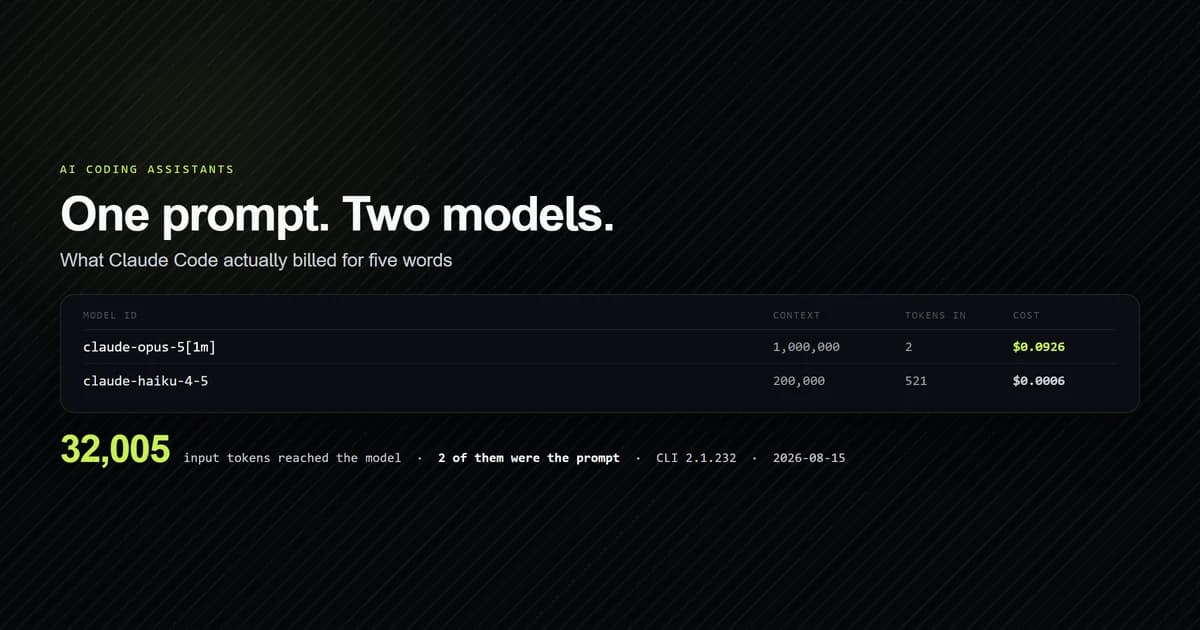
The model is only one layer in the tool. Claude Code's model resolution chain can still select an alias, account default, or settings override, so verify the model reported by your actual client rather than assuming a new release changed it automatically.
Model ID and limits
The Claude API model ID is claude-opus-5-5, with a one-million-token context window and 128,000-token normal output ceiling. Anthropic marks the model active and latest, with retirement not before September 22, 2027.
| Property | Claude Opus 5.5 |
|---|---|
| Released | September 22, 2026 |
| Claude API ID | claude-opus-5-5 |
| Context | 1,000,000 tokens |
| Max output | 128,000 tokens |
| Thinking | Adaptive, always on |
| Default effort | medium |
Those are API specifications, not a guarantee that every product surface exposes the same selector or output ceiling. Pin and inspect the surface you run.
Claude Opus 5.5 pricing
Claude Opus 5.5 pricing has four input-side rates, not one. As verified on 2026-09-30:
| Token class | Standard price per MTok |
|---|---|
| Fresh input | $4.00 |
| 5-minute cache write | $5.00 |
| 1-hour cache write | $8.00 |
| Cache read | $0.20 |
| Output | $20.00 |
The cache line matters in coding agents because a long system prompt and repository context can be read repeatedly. Comparing only $4/$20 misses the term that dominated all three recorded runs below.
Anthropic's launch announcement estimates typical token-billed workloads at about 40% less than Opus 5. Treat that as a vendor estimate until your own traces reproduce it.
Our price replay on recorded Claude Code usage
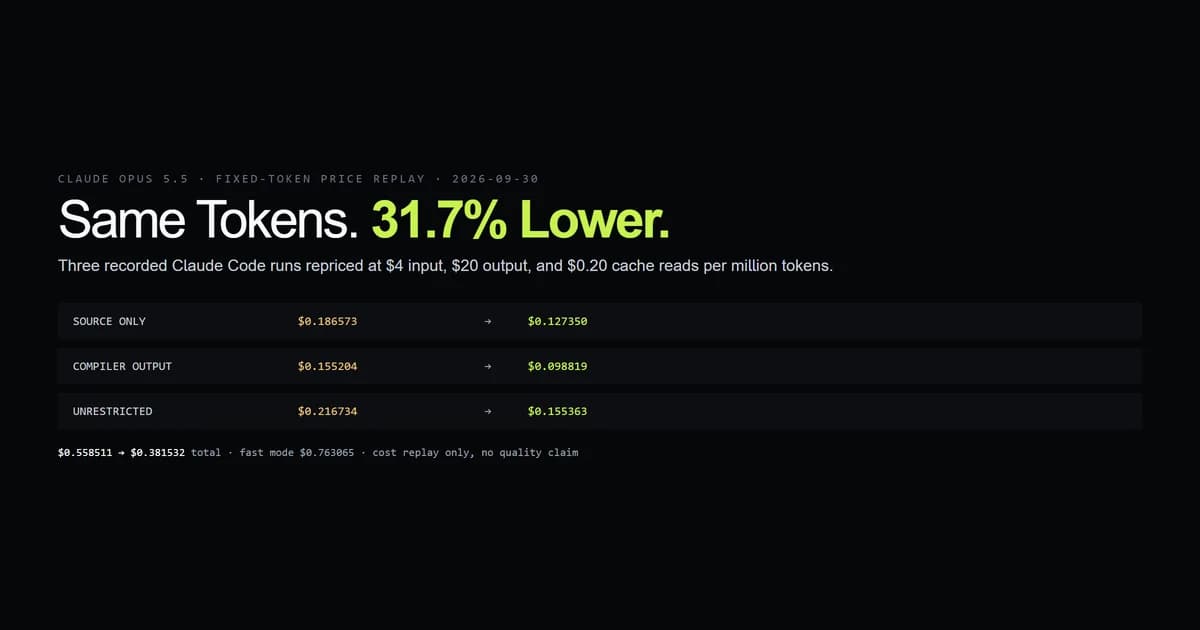
Repricing three captured Claude Code runs at the new standard rates produced $0.381532, 31.7% below their recorded $0.558511 total. The fixture comes from the experiment in Claude Code with TypeScript, captured September 23 on Claude Code 2.1.280. We held all token counts fixed, so the replay isolates the rate card.
| Recorded arm | Original bill | Opus 5.5 standard | Fast mode |
|---|---|---|---|
| Source only | $0.186573 | $0.127350 | $0.254701 |
| Compiler output supplied | $0.155204 | $0.098819 | $0.197638 |
| Unrestricted agent | $0.216734 | $0.155363 | $0.310726 |
| Total | $0.558511 | $0.381532 | $0.763065 |
PASS  three recorded arms loaded
PASS  standard total is $0.381532
PASS  fast mode is exactly 2x standard token price
PASS  repriced total is 31.7% below the recorded bill

4 checks passed. Cost replay only; no quality claim.
The first calculation we considered used only fresh input and output. It was wrong for these traces because cache creation and cache reads carry separate rates. The committed check prices all four recorded token fields and fails if the fixture or arithmetic drifts.
Four breaking changes before you migrate
Existing Opus 5 integrations need compatibility tests in four places. Anthropic's overview identifies these changes:
- Thinking cannot be disabled. Replace an off switch with an appropriate effort level.
- Forced tool use returns an error. Test any request that requires a specific tool choice.
- Thinking blocks are tied to the model and conversation. Do not reuse them across a model switch.
computer_20251124is not accepted on the Claude API or Google Cloud for this model. Update the computer-use tool version.
There is also a response-shape trap: text between tool calls can arrive in thinking blocks with empty text at the default display setting. A progress UI may go quiet without throwing an error. Test the stream consumers, not just the final response.
Standard versus fast mode
Fast mode is a latency purchase at twice the standard input and output token rates. Anthropic says it can run up to 2.5 times faster and lists $8 input and $40 output per MTok.
That trade can make sense for interactive agent loops where model wait time blocks an engineer. It is harder to justify for background analysis, batch work, or queues with loose deadlines. The replay above shows the price boundary clearly: the same three fixed-token runs would cost $0.763065 in fast mode, twice standard and 36.6% above the recorded bill.
What we did not test
We did not run a quality comparison between Claude Opus 5.5 and Opus 5. The replay contains no Opus 5.5 output and supports no claim about correctness, steps, or token efficiency.
We also did not test the one-million-token boundary, 128K output, fast-mode latency, tool-choice error, or computer-use migration. Those are documented capabilities and breaking changes. A production decision should add workload-specific evaluations, especially if the current integration streams thinking or forces tools.
Common mistakes
- Replacing only the model ID. Run compatibility fixtures for thinking, tools, and streaming first.
- Pricing every input token at $4. Split fresh input, cache writes, and cache reads.
- Treating 31.7% as a quality result. It is a fixed-token price replay on three recorded arms.
- Enabling fast mode everywhere. Use it where saved wall time is worth a 2x token rate.
- Assuming Claude Code selected the new model. Read the reported model usage or pin the full ID.
Conclusion
Migrate to Claude Opus 5.5 when you need the Opus tier and can test the four behavior changes. The published price card is materially better for cache-heavy agent work, and our fixed-token replay fell 31.7%, but your real bill also depends on how the new model changes token use. Start on standard mode, validate streaming and tools, then buy fast mode only for tasks where latency has a measured cost.
Frequently asked questions
What is the Claude Opus 5.5 model ID?
How much does Claude Opus 5.5 cost?
What is the Claude Opus 5.5 context window?
Can adaptive thinking be disabled on Claude Opus 5.5?
Is Claude Opus 5.5 cheaper than Opus 5?

Muhammad Kashif
Founder and editor of Devventa, covering AI coding assistants, Next.js and the modern AI development stack.